Fully Automatic Digital Printer with Epson Nozzle: Labor-Reducing Inline Production
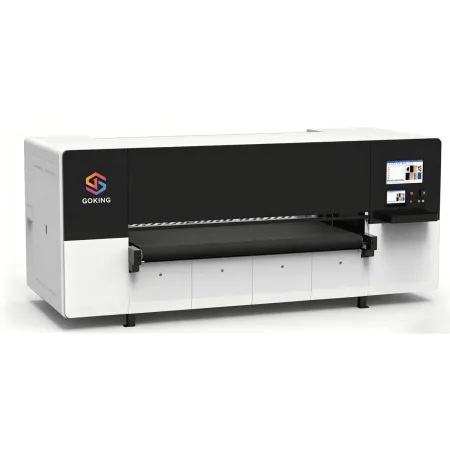
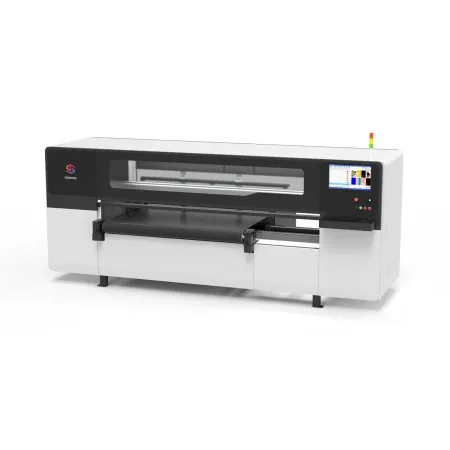
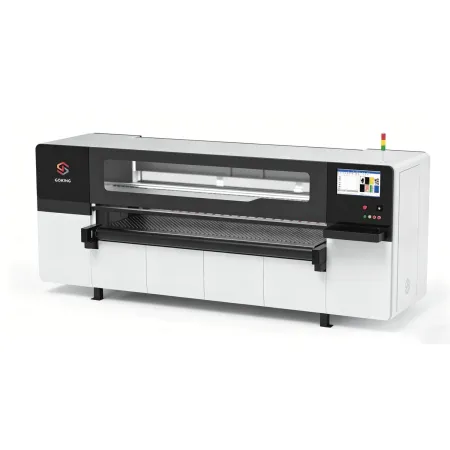
The transition from semi-automatic to a fully automatic digital printer with Epson nozzle represents a fundamental shift in how corrugated packaging manufacturers approach production economics. Where semi-automatic systems require an operator to feed each board into the print zone, a fully automatic system integrates auto-feeding, auto-registration, and inline downstream processing— slotting and auto-collection— into a continuous production line that reduces direct labor to supervisory oversight. Goking engineers these fully automatic systems around Epson Micro Piezo printhead technology, with configurations scalable from 8 to 256 printheads, five-color CMYKW ink capability, and ERP-integrated production control that routes orders directly to the line without manual data entry.
What Defines a Fully Automatic Digital Printer
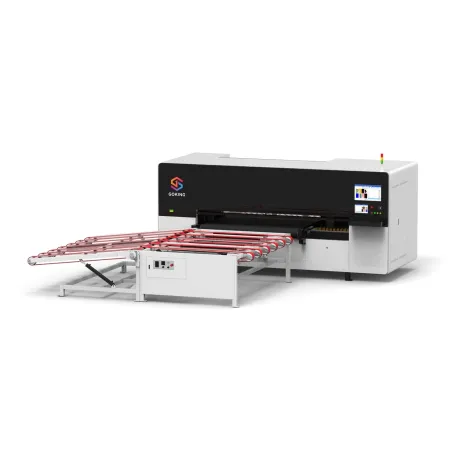
A fully automatic digital printer with Epson nozzle differs from a semi-automatic system in three critical areas: feeding, registration, and downstream integration. In the feeding stage, fully automatic systems use automated feed mechanisms— typically belt-driven or vacuum-assisted— that pull individual sheets from a stack and present them to the print zone at a controlled rate. This eliminates the manual loading step that limits throughput on semi-automatic systems and introduces variability in sheet positioning.
In the registration stage, fully automatic systems use sensor-based auto-registration to align each sheet precisely within the print zone before the Epson printheads begin depositing ink. This automatic alignment ensures that print placement is consistent from sheet to sheet— critical for packaging applications where print-to-slot registration must be accurate to ensure that the printed graphics align correctly with the slots, scores, and folds that the downstream slotting unit creates. The combination of auto-feeding and auto-registration means that the operator's role shifts from active feeding and alignment to supervisory monitoring— checking system status, verifying output quality, and managing job transitions through the ERP-connected control interface.
Inline Production Line Architecture
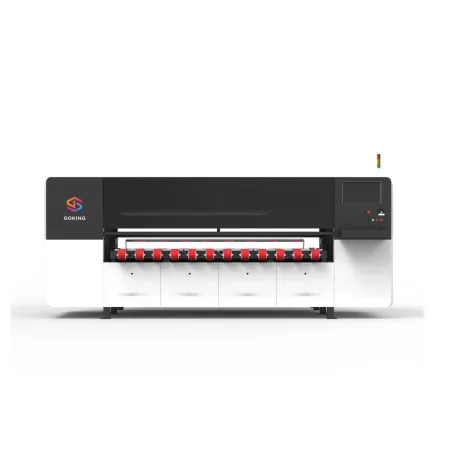
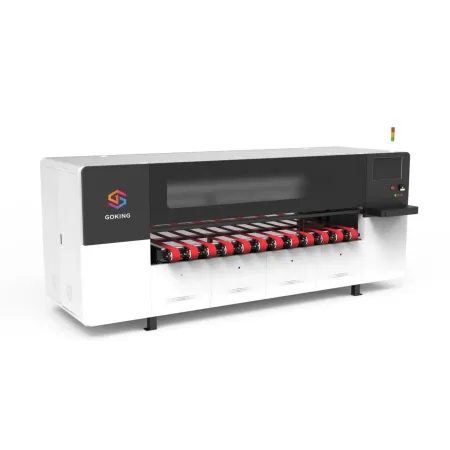
The fully automatic digital printer with Epson nozzle is designed to operate as part of an integrated inline production line. Goking's digital inline architecture consists of three coordinated units: a print unit, a slotting unit, and an auto-collection unit. The print unit houses the Epson printhead array and ink system. The slotting unit performs the cutting and scoring operations that transform a printed sheet into a finished blank ready for folding and gluing. The auto-collection unit stacks and organizes the finished blanks for downstream handling.
| Inline Component | Function | Automation Level |
|---|---|---|
| Print Unit | Deposits CMYKW ink via Epson nozzles | Auto-feed + auto-registration |
| Slotting Unit | Cuts and scores printed blanks | Synchronized with print speed |
| Auto-Collection Unit | Stacks and organizes finished blanks | Fully automatic stacking |
| ERP Integration | Routes orders to line automatically | Digital order management |
These three units operate in synchronization— the slotting unit adjusts its timing to match the print speed, and the auto-collection unit adjusts its stacking rate to match the output of the slotting unit. This synchronized operation means that a corrugated board enters the line as a blank sheet and exits as a printed, slotted, and stacked finished blank without any manual handling between stages. Explore the single-pass inline production architecture to understand how this integration works in high-volume configurations.
Epson Printhead Scalability for Full Automation
Fully automatic systems require high printhead counts to achieve the throughput that justifies the automation investment. Goking's architecture supports configurations from 8 Epson printheads in compact systems up to 256 printheads in large-scale inline production lines. The standard configurations include 8, 12, 16, 24, and 32 heads, with the ability to scale beyond these to meet specific throughput and print width requirements.
In fully automatic single-pass configurations, the large printhead arrays cover print widths up to 795mm and 1050mm, depositing a complete CMYKW image in a single motion as the auto-fed substrate passes through the print zone. The Epson Micro Piezo technology's variable dot capability ensures that even at high production speeds— 45 to 80 meters per minute— the droplet formation remains precise and the print quality remains consistent. This combination of speed and quality is what makes the fully automatic approach viable for corrugated packaging production, where both throughput and print quality directly impact the economic return of the investment.
Speed and Throughput of Fully Automatic Systems
The throughput of a fully automatic digital printer with Epson nozzle depends on the architecture— multi-pass or single-pass— and the printhead configuration. Multi-pass scanning systems, which are typically used in semi-automatic or entry-level automatic configurations, offer speeds from 500 to 1500 meters per hour. These speeds are suitable for short-run, versioned, or sample production where flexibility and quality are the primary performance metrics.
Single-pass systems, which are the architecture of choice for fully automatic high-volume production lines, achieve speeds of 45 to 80 meters per minute. At these speeds, a single-pass inline system with slotting and auto-collection can process a substantial volume of corrugated board per shift, with the auto-feeding mechanism maintaining a continuous supply of substrate to the print zone and the auto-registration system ensuring consistent print placement on every sheet.
The systems accommodate A flute, B flute, C flute, and E flute corrugated board, as well as honeycomb board. The adjustable DPI feature— 600 or 1200 DPI on multi-pass systems— allows operators to optimize for throughput at 600 DPI or for quality at 1200 DPI depending on the requirements of each production order. The single-pass digital print machine specifications provide detailed information on the throughput capabilities of fully automatic configurations.
Labor Reduction and Operational Simplicity
The economic case for a fully automatic digital printer with Epson nozzle rests on labor reduction. In a semi-automatic configuration, each print station requires a dedicated operator to feed boards, monitor registration, and manage output stacking. In a fully automatic configuration, the auto-feeding, auto-registration, and auto-collection systems handle these tasks mechanically, reducing the operator's role to supervisory monitoring and job management through the ERP-connected control interface.
This labor reduction is compounded by the plateless digital workflow. Conventional analog printing requires plate changes, ink mixing, and machine setup that can take 30 to 60 minutes per job. Goking's digital approach eliminates plates entirely, reduces job changes to approximately one minute, and uses CMYK computer color matching to replace manual ink mixing. The combination of automatic feeding, plateless digital printing, and inline slotting means that job changeovers happen in minutes rather than hours, and the production line can switch between different box sizes, designs, and board types with minimal downtime.
Simple operation is a design principle across the Goking product range. The control interface is designed for operators who may not have extensive digital printing experience, with CMYK computer color matching handling the color science automatically and adjustable DPI settings allowing quality adjustments without hardware changes. The 3000KG system weight and rigid frame construction ensure stability and printhead alignment over long production runs, reducing the maintenance interventions that would otherwise require operator attention. Learn more about Goking's manufacturing standards and facility to understand the engineering behind these systems.
Environmental Efficiency in Fully Automatic Operation
Fully automatic operation contributes to environmental efficiency in two ways. First, the elimination of plate-making removes the chemical waste, water consumption, and material waste associated with conventional plate production and disposal. Second, the precise droplet control of Epson Micro Piezo printheads minimizes ink waste by depositing only the droplet volume needed for the target density, while the plateless digital workflow eliminates the setup waste— test prints, alignment sheets, and color proofs— that analog systems generate during changeover.
Goking's systems are designed for low power consumption overall. The auto-feeding and auto-registration mechanisms are engineered for energy efficiency, and the continuous production flow of a fully automatic line means that the print unit, slotting unit, and auto-collection unit all operate at their optimal efficiency point rather than the stop-start cycling that characterizes semi-automatic production. The 10,000 square meter manufacturing facility in Dongguan Huangjiang Town, Guangdong, assembles these systems to industrial-grade standards, with each unit weighing approximately 3000KG reflecting the robust construction that continuous automated production requires.
Frequently Asked Questions
What is the difference between semi-automatic and fully automatic feeding?
Semi-automatic systems require an operator to feed each board manually. Fully automatic systems use auto-feeding mechanisms that pull sheets from a stack and present them to the print zone at a controlled rate, reducing labor to supervisory oversight.
What components are included in the inline production line?
The digital inline architecture includes a print unit, a slotting unit, and an auto-collection unit, all coordinated through ERP system integration.
How many Epson printheads can a fully automatic system use?
The architecture supports 8 to 256 Epson printheads, with standard configurations at 8, 12, 16, 24, and 32 heads. Large-scale inline single-pass systems can scale to 256 heads.
What speed can fully automatic single-pass systems achieve?
Single-pass systems operate at 45 to 80 meters per minute, with print widths up to 795mm and 1050mm.
Conclusion: Automate with Epson-Powered Precision
A fully automatic digital printer with Epson nozzle from Goking transforms corrugated packaging production from a labor-intensive, plate-dependent process into a continuous, digitally controlled inline workflow. The integration of auto-feeding, auto-registration, inline slotting, and auto-collection— coordinated through ERP connectivity— reduces direct labor to supervisory monitoring while maintaining the print quality that Epson Micro Piezo variable dot technology delivers. With printhead configurations scaling from 8 to 256 heads, print widths up to 1050mm, and single-pass speeds up to 80 meters per minute, these systems serve the full range of corrugated packaging production from versioned short runs to high-volume continuous lines.
The plateless workflow, CMYK computer color matching, adjustable DPI, and low power consumption make the system as operationally efficient as it is labor-efficient. And the environmental benefits— no plate-making waste, no VOC emissions with UV ink, and minimal ink waste through precise droplet control— align with the sustainability commitments that increasingly define the corrugated packaging industry.