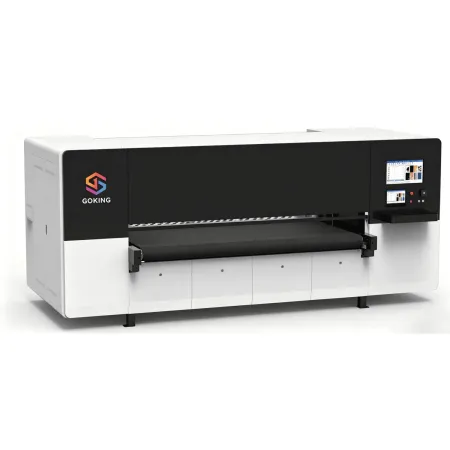
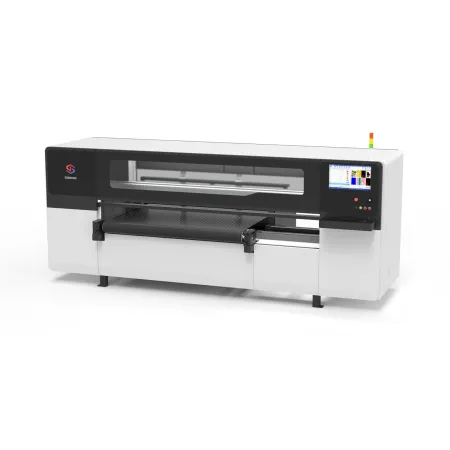
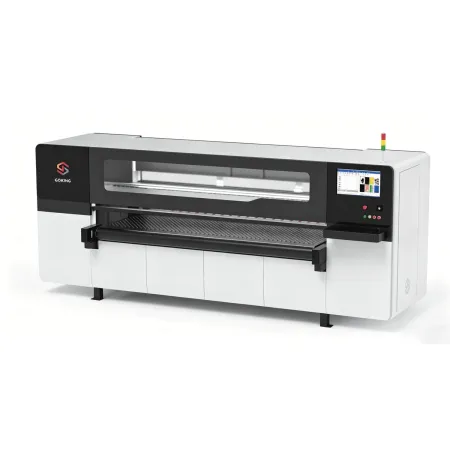
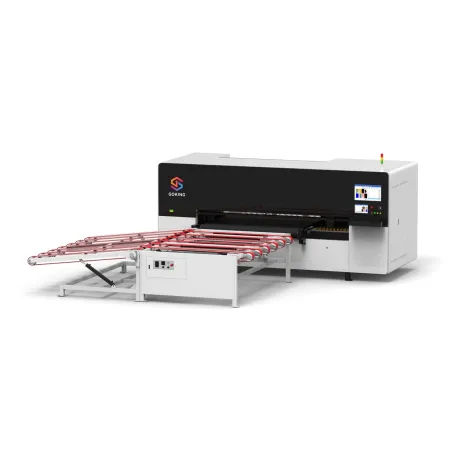
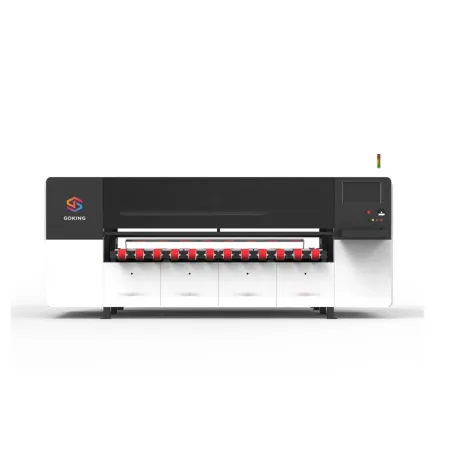
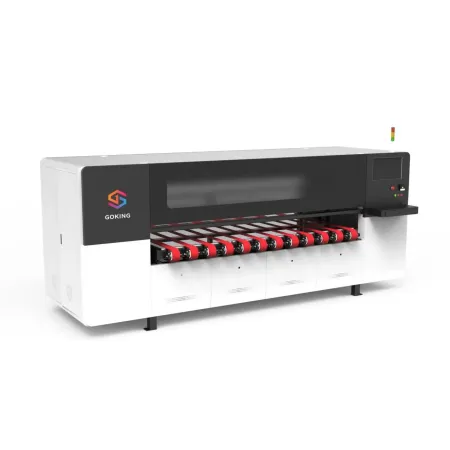
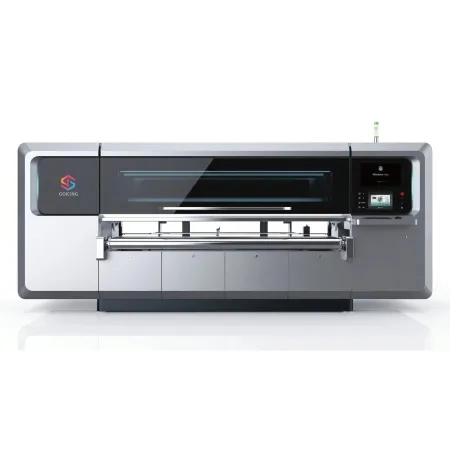
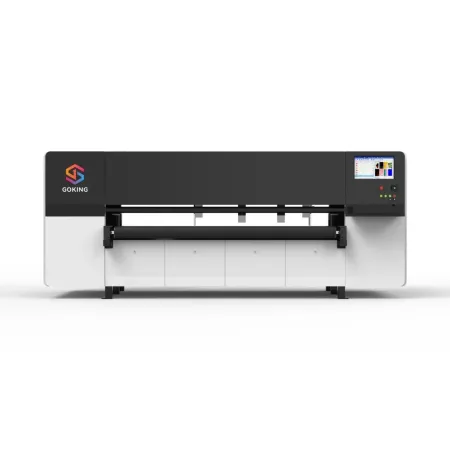
Digital Printer for Corrugated Paper with UV Ink: Instant Cure for High-Speed Production Lines
A digital printer for corrugated paper with UV ink technology solves one of the most persistent challenges in corrugated packaging production: drying time. Traditional water-based and solvent-based inks require extended drying tunnels, heat lamps, or air-cycling stations that slow production and consume significant energy. UV ink, by contrast, cures instantly under UV LED irradiation — the moment ink leaves the printhead and contacts the substrate, the curing process begins. Goking integrates UV ink technology across its J-series multi-pass and G-series single-pass platforms, enabling converters to print on A, B, C, and E flute corrugated board with immediate handling readiness and zero drying-related bottlenecks.
What Makes UV Ink Transformative for Corrugated Packaging?
UV ink is a 100% solids formulation — meaning it contains no water or solvent carriers that must evaporate. Instead, the ink polymerizes (cross-links) when exposed to ultraviolet light, transforming from liquid to solid in a fraction of a second. This chemical transformation, rather than physical evaporation, is what enables instant curing and creates several operational advantages specific to corrugated packaging production.
Why does instant cure matter on a corrugated production line? When ink dries immediately, the printed board can move directly to the next process step — die-cutting, folding, gluing, or stacking — without waiting in a drying zone. This eliminates the production bottleneck that drying represents in conventional systems and allows the digital printer to operate at the full speed of the inline production line. For converters running Goking's single-pass ONEPASS systems at 45 to 110 meters per minute, instant cure is not a luxury — it is a prerequisite.
UV ink also delivers superior adhesion and durability on corrugated substrates. Unlike water-based inks that can rub off or scratch during downstream handling, cured UV ink forms a tough polymer film that resists abrasion, moisture, and handling damage. This durability is particularly valuable for shipping cases and transport packaging that undergo automated sorting, palletizing, and distribution handling.
UV Ink Across Goking's Platform Series: Configuration Options
A digital printer for corrugated paper with UV ink must be matched to the correct platform architecture. Goking offers UV ink compatibility across multiple series, each with distinct speed and color capabilities. The table below maps UV ink configurations to their corresponding production parameters.
| Platform | Printhead | Color Capability | Speed | UV Ink Advantage |
|---|---|---|---|---|
| J-series multi-pass | Epson I3200/I1600 | 5-color CMYKW | 500-1500m/h | Instant cure, no drying wait |
| G-series (Xaar) | Xaar 6-12 heads | 5-color CMYKW | 500-1000m/h | Variable drop 9-215pl |
| G-series (Seiko) | Seiko 4-18 heads | Single-color | 70-110m/min | High-speed marking, 3500KG stability |
| GJ series 2-in-1 | Epson + Xaar/Seiko | Flexible CMYKW | Multi-pass to single-pass | Adaptive cure for mixed production |
The Xaar-based G-series with UV ink is particularly noteworthy — its variable drop volume range of 9 to 215 picoliters allows the system to deposit everything from fine text droplets to heavy coverage fills, all cured instantly. Learn more about key features across all platforms.
Digital Printer for Corrugated Paper with UV Ink: Environmental and Operational Benefits
UV ink technology aligns with the corrugated packaging industry's increasing focus on environmental responsibility — not through marketing claims, but through measurable operational characteristics that reduce resource consumption and waste.
Low power consumption: UV LED curing systems consume substantially less energy than the thermal drying tunnels required for water-based inks. Conventional drying systems must heat large volumes of air and maintain elevated temperatures throughout the drying zone — a continuous energy drain that UV curing eliminates entirely. Goking's eco-friendly low-power design philosophy is amplified when paired with UV ink, as the total system energy footprint drops significantly.
Zero VOC emissions: Because UV ink contains no solvents, there are no volatile organic compound emissions during the curing process. This eliminates the need for ventilation infrastructure required by solvent-based systems and creates a safer working environment for press operators. For converters operating in regions with strict air quality regulations, UV ink provides a compliance-friendly pathway.
Reduced material waste: Instant curing means no smearing, no set-off (ink transfer to the back of stacked sheets), and no rejected boards due to incomplete drying. The first board off the printer is ready for downstream processing — reducing the test-run waste that conventional systems generate during warmup and drying stabilization. The single-pass digital print machine with UV ink maximizes this efficiency advantage.
No plate-making waste: Combined with Goking's no-plate-making workflow, UV ink digital printing eliminates both the material waste of plate production and the setup waste of conventional ink systems. One-minute job changeover means the system transitions between jobs with minimal substrate waste — a critical advantage for short-run corrugated packaging where setup waste can represent a significant percentage of total material consumption.
How Does UV Ink Perform on Different Corrugated Flute Grades?
Corrugated board is not a uniform substrate. A, B, C, and E flute grades differ in flute height, pitch, and surface characteristics — and a digital printer for corrugated paper with UV ink must handle all of them without adjustment compromises. UV ink's instant cure characteristic provides a distinct advantage here: because the ink does not penetrate the substrate (it cures on the surface), print quality remains consistent regardless of the board's moisture absorption characteristics.
E flute (fine flute): The smooth surface of E flute board is ideal for high-resolution graphics. UV ink's surface-curing behavior produces sharp, well-defined dots that preserve the 600 or 1200 DPI resolution of Goking's Epson-based J-series. Fine text, barcodes, and photographic images render with exceptional clarity on this substrate.
B and C flute (medium to large flute): These grades present a more textured surface due to the larger flute profile. UV ink's ability to build opacity through layered deposition — particularly with the white (W) channel in CMYKW configurations — ensures full color coverage even across the valleys and peaks of the flute structure. The instant cure prevents ink from flowing into flute valleys before solidifying, maintaining consistent color density across the print width.
A flute (large flute): The thickest corrugated grade demands a printer with adequate head clearance and a robust feeding system. Goking's platforms accommodate the thickness range of A flute board, and UV ink's surface-cure characteristic ensures that even on this challenging substrate, printed graphics achieve the durability and color fidelity required for heavy-duty shipping containers.
Frequently Asked Questions
Q: Is UV ink safe for food packaging applications on corrugated board?
A: UV ink technology is widely used in packaging applications. Cured UV ink forms an inert polymer film that does not emit volatile compounds after curing is complete. For corrugated packaging — which typically serves as outer transport packaging rather than direct food contact — UV ink provides a compliant solution. Converters should verify specific regulatory requirements for their target markets and end-use applications, and Goking's technical team can provide guidance on ink formulation selection for specific compliance needs.
Q: How does UV ink cost compare to water-based or solvent-based inks?
A: UV ink typically carries a higher per-unit cost than water-based alternatives, but the total cost comparison requires looking beyond per-liter pricing. UV ink's 100% solids formulation means nearly all of the ink deposited on the substrate remains there — there is no carrier liquid that evaporates. This translates to higher effective coverage per unit of ink. Combined with the elimination of drying-related energy costs, reduced waste from setup and smearing, and lower infrastructure requirements (no drying tunnels or ventilation systems), the total operating cost of UV ink systems is competitive with conventional ink systems in production corrugated environments.
Q: Can a digital printer for corrugated paper with UV ink handle both CMYKW and single-color production?
A: Yes, depending on the platform. Goking's J-series with Epson printheads and G-series with Xaar printheads both support 5-color CMYKW UV ink configurations, providing full-color capability for premium packaging and graphics-heavy applications. The Seiko-based G-series variant, configured for single-color high-speed printing at 70-110m/min, uses UV ink for rapid single-color marking, coding, and branding on corrugated cases. The GJ series 2-in-1 platform can switch between these modes — giving converters the flexibility to run full-color short-run jobs and high-speed single-color production on the same factory floor. See the printhead options for detailed configurations.
Unlock Instant-Cure Production on Your Corrugated Line
Goking's UV ink digital printing systems — from Epson multi-pass to Xaar single-pass to Seiko high-speed marking — deliver instant cure, zero drying bottlenecks, and eco-friendly operation across A, B, C, and E flute corrugated grades. Connect with our engineering team to configure the right UV ink platform for your production volume.
Discover UV Ink Printing Solutions