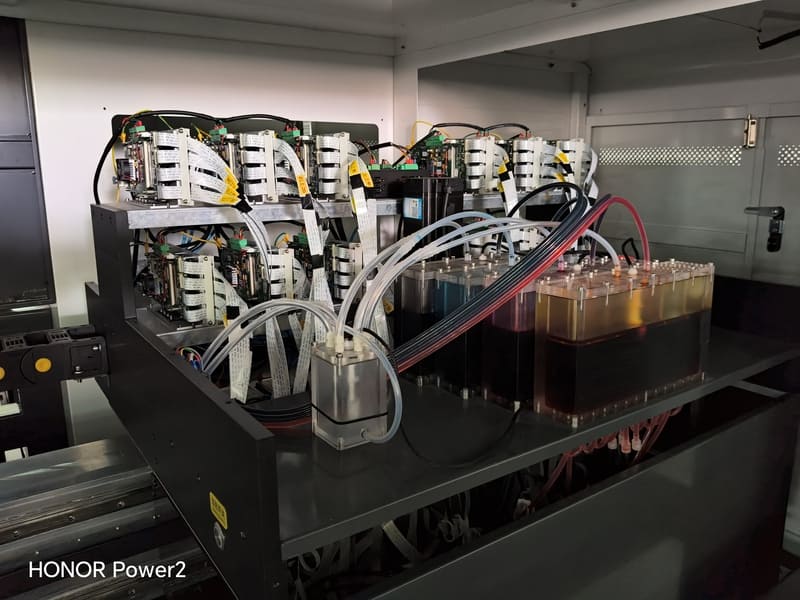
A coated paper printer has an easier substrate to please than a corrugated press and a harder one to keep flat. Coated stock gives you the smooth, closed surface that makes fine detail and rich colour possible — and it also gives you curl, smear, and mottling when the ink, the primer, and the drying stage are not matched to it. Most of the coated-paper complaints that reach our technical team are not printhead faults at all. They are finishing faults that show up during printing.
I have spent 15+ years on the export side of packaging machinery, and coated stock cases are the ones where I most often need a sample in hand before I can answer. Gift boxes, cosmetics cartons, premium retail sleeves, brand collateral — the customers who print on coated paper are usually the ones with the least tolerance for imperfection, because the whole point of the material is that it looks expensive. Let me go through what actually goes wrong, and what a machine has to do to keep coated work clean.
In one sentence: coated paper fails in three predictable ways — curl, smear, and mottling — and a coated paper printer prevents them by controlling ink laydown with a primer, drying the sheet gently rather than brutally, and holding the sheet flat and still during transport.
Why Coated Stock Behaves Differently
Corrugated board is a sponge: it absorbs ink quickly and forgives a lot. Coated paper is the opposite. Its surface is a layer of mineral pigment bound to the base sheet, engineered to sit on top of the fibres so the ink stays sharp. That closed surface means the ink cannot wick away, so where it lands it stays — which is exactly why coated paper gives crisp edges, and exactly why it shows every flaw in drop placement.
The second difference is mechanical. Coated sheets are thin, and their two faces are not identical. Printing on one face adds moisture to one side of a sheet that is already under tension, and the paper will try to relieve that imbalance by curling. This is why machines that handle coated work well are designed around sheet control, not just image quality.
The Three Failure Modes and What Causes Them
When a coated job comes back looking wrong, the symptom usually points straight to the cause. In our experience the three below account for the large majority of cases.
| Symptom | Usual cause | What fixes it |
|---|---|---|
| Sheet curl, edges lifting | One-sided moisture gain combined with aggressive heating | Gentle, controlled drying and flat sheet support through the print zone |
| Smearing, set-off, blocking in the stack | Ink sitting wet on a closed surface because it never anchored | A primer stage that gives the ink something to bond to, plus proper drying |
| Mottling, patchy solids | Uneven primer application or inconsistent drop formation at high speed | Even primer metering and a head platform with a wide, controllable drop range |
Note what is not on that list: resolution. I have never solved a curl or a smear problem by pushing DPI higher. If the ink cannot anchor to the surface and the sheet cannot stay flat, more dots per inch simply gives you a sharper version of a bad print.
The Primer Stage: Giving Ink Something to Hold
A primer is a thin, evenly applied layer that changes how the ink behaves when it lands. On a closed coated surface, a water-based ink without primer tends to sit on top, bead slightly, and take a long time to set. Adding a controlled primer layer gives the pigment something to key into, which produces three benefits at once: cleaner edges, denser solids, and a much shorter window before the sheet can be handled.
The word that matters in that sentence is evenly. A primer applied unevenly creates a surface that absorbs ink at different rates across the sheet, and the resulting print shows it as patchy solids — the mottling in the third row of the table above. On our platforms the primer stage is designed as part of the ink path rather than as a bolt-on, because a press that treats primer as an afterthought will produce coated work that looks inconsistent across the run.
Low-Heat Drying: The Tradeoff You Have to Plan For
Here is where coated paper forces an honest conversation about speed. Corrugated board can take heat. Coated paper punishes it: aggressive drying drives moisture out of the top surface faster than the base sheet can equalise, and the sheet responds by curling. Run that stack through a folder or a die-cutter and the curl becomes registration trouble on the next operation.
The answer is drying that is effective but gentle — bringing the ink to a set state without baking the sheet. UV-curable systems handle this elegantly, because the ink is set by exposure rather than by evaporating water out of the paper, which leaves the sheet's moisture balance almost untouched. That is one reason UV configurations are so common on premium packaging work: the cure is instant, so sheets can go straight into the next stage with no drying racks and no waiting. For water-based systems, the drying stage has to be tuned per stock, and the honest advice we give customers is to accept a slightly lower line speed on the most sensitive coated grades rather than fight the curl all shift.
Keeping a Thin, Slippery Sheet Still
Coated sheets are thin and their surfaces are smooth, which makes them harder to transport predictably than board. Static builds up between the sheets, air can get trapped between the stack layers, and a sheet that shifts by a fraction of a millimetre mid-pass ruins the registration of everything printed after it. Because there is no plate to reference, the press has to get its position information from the sheet itself, which puts the whole burden on the transport and feed design.
This is why we pay attention to three things that never appear in a marketing specification: the feed section, the static control around the print zone, and the flatness of the sheet path. Our platforms are available with semi-automatic or fully automatic leading-edge feeding, and on coated work the automatic option earns its cost quickly, because consistent sheet delivery is what keeps registration steady across a long shift. Dust and paper debris matter as much here as on corrugated — a coated sheet still sheds coating particles, and those particles find printheads.
Matching the Head Platform to Coated Work
Once the physical problems are handled, coated paper rewards the right printhead far more generously than corrugated does, because the surface can actually hold fine detail. For this kind of work we usually recommend an Epson Micro Piezo configuration — 8, 12, 16, 24, or 32 heads at either 600 or 1200 DPI, with five-colour CMYKW coverage. The piezoelectric mechanism gives you fine control over drop size, which is what makes 1200 DPI on coated stock look like a print rather than a printout.
White ink is worth its own mention for premium work. A five-colour CMYKW system lets you lay an opaque white base before printing colour on top, which is how you get bright graphics on tinted or dark coated stock without the washed-out look that comes from printing colour directly onto a coloured surface. If your gift box or retail sleeve work involves any non-white substrate, the white channel is not an optional extra — it is the difference between the design you approved and the design that ships. You can see how the CMYKW configurations are grouped on our Epson series page and under the five-colour line configuration.
A Coated Paper Case From Our Own Files
A gift box manufacturer in Southeast Asia approached us with a coated board job that had been through three suppliers. Their complaint was simple: the first proofs were beautiful, and production output was not. At speed, the solids mottled and the sheets curled enough to jam the folder downstream. When we asked about their process, one detail explained most of it — they were running the coated stock through a drying profile that had been set up for their corrugated work.
We rebuilt the recipe for that stock: primer metering evened out, drying brought down and extended rather than shortened, and line speed trimmed on the heaviest coated grades. Output dropped by a small margin. Scrap dropped by a much larger one, and the mottling disappeared. The plant's own summary was better than mine: they had been paying for speed with rejects, and the rejects cost more than the speed was worth.
What to Test Before You Buy a Coated Paper Printer
- Bring your actual coated stock, including the heaviest and the thinnest grade you run, not a generic sample sheet.
- Print a job with large solid panels, because solids reveal mottling and primer inconsistency faster than fine detail does.
- Print a job with dense white coverage if you ever print on non-white stock.
- Watch the sheet leave the press and go straight into the next operation without a pause. What happens in that handoff tells you more than the print itself.
- Ask what happens to the drying recipe when the plant humidity changes. If the answer is vague, expect to spend time on it later.
FAQ — Coated Paper Printing Problems
Why does coated paper curl right after printing?
Printing one face adds moisture to one side of a thin sheet, and heat accelerates the imbalance. Gentler drying, flat sheet support, and letting the stack equalise before the next operation all reduce it.
Does a coated paper printer need a primer?
For water-based ink on closed coated surfaces, a primer is usually what makes the ink anchor. Without it, the ink sits on the surface and you get smear, set-off, and slow handling.
Is UV ink better than water-based ink on coated stock?
UV ink sets by exposure rather than by evaporating moisture out of the sheet, which limits curl and lets sheets move straight into finishing. Water-based systems work too, but the drying stage needs more tuning per stock.
How many printheads do I need for premium coated work?
Head count follows print width and required throughput more than quality. Quality comes from the head family and DPI setting; our Epson-based configurations run 8 to 32 heads at 600 or 1200 DPI, with five-colour coverage where white is needed.
Final Word: Treat Coated Paper as a Process, Not a Stock
Coated paper is unforgiving in a very specific way: it shows exactly what your process is doing. Curl, smear, and mottling are not bad luck — they are messages. Read them, fix the primer and the drying, keep the sheet flat and still, and match the head platform to the detail the surface can hold. Do that and a coated paper printer becomes one of the most flexible tools in the plant, because the same machine that runs premium gift boxes can run retail sleeves and brand collateral without a plate anywhere in sight.
If you want to see how a coated job behaves on your own stock, send us the grade and the artwork. Our technical team will run the recipe and send the sheets back for you to judge, rather than describing the result in an email.
Printing premium packaging on coated stock?
Compare the 600 and 1200 DPI configurations and see which fits your gift box and retail sleeve range.
Compare Coated Paper ConfigurationsSend us your coated stock and we will run the test
Tell us the grade, the grammage, and the finish you need, and we will show you what a coated paper printer does with that exact stock.
Request a Coated Stock Sample Run