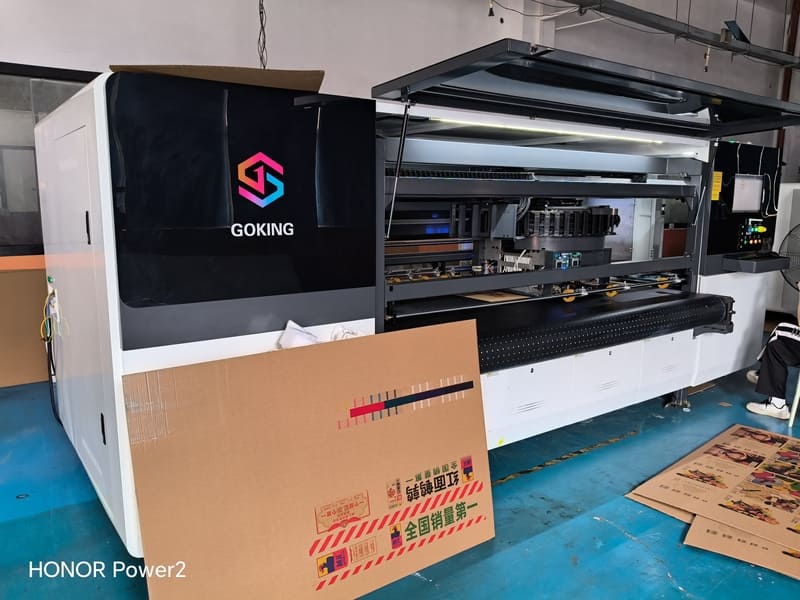
Ask a buyer what they need from a digital printer for corrugated paper and they will usually talk about print width. Ask a plant manager and they will talk about flute grade, because thickness is what decides whether a press runs smoothly all shift or needs constant attention. E-flute and double-wall BC board are not variations on the same job — they behave like different materials, and a press that handles one beautifully can struggle with the other.
I have spent 15+ years on the export side of packaging machinery, and the specification conversations that go wrong are almost always the ones that never mentioned thickness. A converter sends board samples that are all one grade, approves the print, buys the machine, and then discovers a second grade in their own order book that behaves nothing like the sample. Let me explain what actually changes with flute height, and how the machine has to be built to cope.
In one sentence: flute grade changes print height, feed behaviour, crush risk, and ink absorption all at once, so a digital printer for corrugated paper has to adjust its transport and its print gap per grade rather than run one setting for everything.
Thickness Is the First Question, Not Print Width
Corrugated board is a sandwich: two liners with a fluted medium between them, and the height of that flute sets the thickness. A-flute is the tallest of the common single-wall grades, C-flute sits slightly below it, B-flute is shorter still, and E-flute is thin enough to feel like heavy card. Then there is the double-wall family — BC, EB, and similar combinations — where two flutes are glued together into a much thicker, much stiffer sheet. Honeycomb board goes further again, with a cellular core rather than a fluted one.
Why does this matter more than artwork? Because everything the press does happens at a fixed distance from the printhead. Change the board thickness and you change the distance from nozzle to surface, the stiffness the feed rollers have to overcome, and the amount of air trapped in the structure. A machine set up for E-flute, then asked to run BC, is being asked to work at a different geometry with the same settings.
What Changes With Each Grade
The table below summarises the practical differences we work through with customers. It is deliberately qualitative — the exact behaviour depends on the liner, the moisture content, and the converter's own board supply — but the pattern holds across plants.
| Grade | What the press has to cope with | Practical consequence |
|---|---|---|
| E-flute | Thin, flat, and stiff; feeds predictably and holds shape | The easiest grade to print, with the most stable registration |
| B-flute | More thickness and a coarser surface on the liner | Fine detail softens; solids absorb unevenly if ink laydown is not matched |
| C-flute | Taller flute, more air inside, greater crush sensitivity | Feed settings need to be gentler; over-compression damages the flutes |
| A-flute | Tallest single wall; least tolerant of tight transport geometry | Print gap and feed pressure must be set per grade, not shared |
| BC and EB double wall | Heavy, thick, and stiff; needs real force to feed evenly | Registration drift shows up first on these grades if the feed is set light |
| Honeycomb board | Rigid core, open edges, and an uneven print surface | Survivable if print height and support are planned; not a default job |
The Print Gap: Small Distance, Large Effect
The distance between the nozzle plate and the board surface is one of the most consequential settings on the machine, and thickness changes it directly. Too close and the board risks contacting the head — an expensive event. Too far and drops scatter before they land, softening edges and dulling solids. That is why a press set up for one grade will rarely print another grade well without adjustment.
Our platforms cover print widths from 200 mm to 1800 mm depending on the head family and configuration, and across that range the machines are designed to be set per grade rather than once. In practice the operator stores a recipe for each board they run — E, B, C, BC, honeycomb — and recalls it when the job arrives. That single habit removes most of the drift complaints we hear from plants that run a mixed queue.
Crush: The Damage You Cannot See Until the Box Fails
Corrugated board exists to protect what is inside it, and that protection comes from the flute structure. Squeeze the flutes and the board loses stacking strength, even though the print may look perfect. Taller flutes crush more easily than short ones, which is why A-flute and C-flute are the grades where over-compression becomes a real risk.
This is a transport-design problem, not an ink problem, and it is one of the reasons we build in adjustable feed pressure rather than a single fixed setting. The goal is enough grip to move the sheet predictably and not a gram more. When a plant reports boxes that measure correctly but fail a stacking test, crush in the feed section is the first thing we check.
Ink Absorption Varies With the Liner, Not Just the Flute
Two boards with the same flute grade can print very differently if their liners differ. An uncoated kraft liner drinks ink and softens edges; a coated white-top liner behaves much more like paper and holds fine detail. A recycled liner sits somewhere in between and often varies from batch to batch, which is where inconsistency complaints usually originate.
The practical answer is a head platform with a wide, controllable drop range and a five-colour CMYKW capability. On uncoated or recycled liners, a heavier drop builds the density the surface needs; on coated liner, a lighter drop keeps detail crisp. White ink matters on any board whose liner is not white — a kraft or brown liner printed directly in colour will always look muted compared with the same artwork laid over a white base. You can see how the five-colour configurations are grouped on our five-colour line page.
Configuring a Digital Printer for Corrugated Paper
With thickness understood, the configuration questions get simpler. Match print width to the widest artwork in your order book — common steps across our range include 264 mm, 400 mm, 525 mm, 795 mm, and 1050 mm, with industrial platforms reaching 1800 mm. Choose throughput against your longest run: scanning configurations run in the hundreds of metres per hour up to around 1500 m/h, while single-pass configurations are measured in tens of metres per minute, from 45 m/min up to 110 m/min on the widest industrial platforms.
Then decide whether you need in-line finishing. Our machines can be connected to a high-speed printing unit, a slotting unit, and an automatic stacking unit, so printed board can leave the line slotted and counted. On a mixed-grade schedule, that is a bigger productivity gain than a small increase in print speed, because it removes a handling step that would otherwise be repeated for every job in the queue.
A Mixed-Grade Queue We Worked Through
A plant in the Gulf region bought a press to run promotional cartons and approved it on E-flute samples. Within three months they reported two problems: fine text on B-flute looked soft, and images shifted on the double-wall work they occasionally ran. Neither was a machine fault. The press was being operated on one recipe for everything.
We spent a day with their team building grade recipes — print height, feed pressure, and ink laydown stored separately for E, B, C, and BC. The B-flute text firmed up because the drop profile matched the liner. The double-wall drift disappeared because the feed was no longer set light for a heavier board. The plant now adds a new recipe whenever a new grade enters the order book, and the complaints have not returned.
FAQ — Printing on Different Flute Grades
Can one digital printer for corrugated paper run every flute grade?
Most of our platforms cover A, B, C, and E single wall plus double-wall combinations and honeycomb board, provided each grade has its own stored recipe. Trying to run every grade on one setting is what causes most complaints.
Why does registration drift on thicker board?
Heavier board needs more feed force to move at a consistent rate. If the feed is set for a thin grade, a thick sheet slips or hesitates, and the image lands off position. Per-grade feed settings solve it.
Does printing crush the board?
It can, if the feed pressure is excessive on tall flutes. Crush reduces stacking strength without affecting the print, so it is easy to miss until a box fails a load test.
Is E-flute a good grade to run first?
Yes, for proving a machine. It feeds predictably and holds registration easily, so it isolates any transport or head issues from board-related ones. Just do not approve a press on E-flute alone if your order book includes heavier grades.
Final Word: Approve the Press on Your Thickest Board
Flute grade decides how a press behaves more than any other single variable, and it is the variable buyers most often leave out of the conversation. Bring the full range of grades you run to the evaluation, insist on stored recipes per grade, and check the feed section on your heaviest board rather than your thinnest. A digital printer for corrugated paper that has been approved across every grade in your order book will keep performing when the queue gets mixed — which, in a real plant, is most days.
Send us your board grades and a typical job list, and our technical team will tell you which recipe set you need and where the machine is likely to need the most attention.
Running more than one flute grade?
Compare the configurations and the widths available, then pick the platform that covers your heaviest board as well as your thinnest.
Find a Platform for Your Board MixTell us your flute grades and we will map the settings
Send the grades you run, including any double-wall work, and we will show you what a digital printer for corrugated paper needs to hold registration on each of them.
Request a Grade Setup Guide