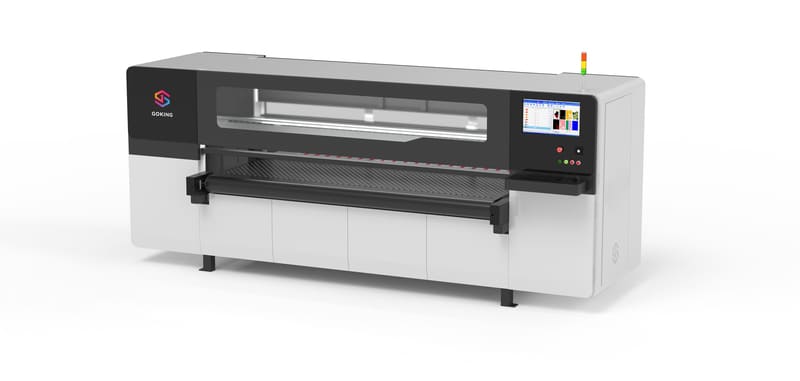
The industry narrative says single-pass is the future and multi-pass is the compromise. That story is true for long runs of standard corrugated board, and misleading everywhere else. A multi-pass digital printing machine remains the better tool for heavy board, uneven or warped sheets, and the specialty substrates that turn up in real order books — mounted board, honeycomb cores, thick double wall, and rigid material. The reason is partly mechanical and partly economic, and neither has changed.
I have spent 15+ years on the export side of packaging machinery, and I have had this conversation with customers who came to us convinced they needed the fastest machine available. Some of them did. Others were about to spend money on throughput they could not use, because their jobs were built on substrates a single-pass platform would fight. Let me explain the trade-off properly.
In one sentence: a scanning, multi-pass press builds an image over several passes with a short, moving print bar, which makes it more tolerant of thick, uneven, and unusual substrates than a fixed wide bar — and gives it an advantage in resolution and colour density that single-pass cannot match at the same cost.
How Multi-Pass Builds an Image
The mechanical difference is simple to picture. In a scanning configuration, the print bar travels back and forth across the sheet, laying ink in successive passes and stepping along the board as it goes. In a single-pass configuration, a fixed bar spans the full print width and the board passes beneath it once. Single-pass is faster because the board moves continuously and only one pass is needed. Multi-pass is more controllable because the image is assembled in layers, with each pass adding density and detail.
That layering has a quality consequence worth stating plainly: where the artwork needs deep colour or very fine gradation, several lighter passes usually produce a better result than one heavy pass. Building density gradually lets the ink settle into the substrate instead of pooling on the surface, which is why scanning presses have historically been the tool of choice for detailed graphics on absorbent or textured materials. In our range, scanning configurations are available with 8, 12, 16, 24, or 32 Epson Micro Piezo heads at 600 or 1200 DPI, with throughputs from around 700 to 1500 m/h depending on the setup.
Heavy Board: The Mechanical Argument
Thick board creates two problems for any inkjet press, and their severity depends on the substrate rather than the artwork. The first is print height: the distance from nozzle plate to board surface grows as the flute gets taller, and a surface that is also uneven means that distance keeps changing across the sheet. The second is flatness. Heavy double-wall board and mounted board do not always arrive flat, and a warp of a few millimetres is enough to put part of the sheet beyond the working range of a fixed bar.
A scanning bar is inherently more forgiving here because the head passes over the board repeatedly rather than once at full width. That gives the machine more opportunity to compensate, and it makes the gap setting a per-grade decision rather than a global compromise. In practice, plants running A-flute, C-flute, and double-wall BC on the same day are usually better served by a scanning platform, provided each grade has its own stored recipe.
Specialty Substrates Beyond Corrugated
The substrates that most clearly favour multi-pass are the ones that were never designed with printing in mind. Honeycomb board has a rigid cellular core and an open edge, so its surface does not behave like a liner at all. Mounted board — corrugated laminated with a printed sheet or a heavy liner — can be thick, dense, and slightly irregular. Rigid and heavy display board for point-of-sale work is often outside the flatness assumptions of a continuous-feed single-pass line.
Our own platforms are specified for A, B, C, and E flute, double-wall combinations, and honeycomb board, and the practical difference between running those grades on a scanning press and on a fixed-bar press shows up in registration consistency rather than in headline speed. When a plant tells us that images drift on their heaviest board, the first question we ask is which platform the job is running on and whether the recipe was set for that grade.
| Consideration | Multi-pass scanning | Single-pass |
|---|---|---|
| Throughput | Measured in hundreds of metres per hour, up to about 1500 m/h | Measured in metres per minute, from 45 m/min upward |
| Thick and uneven board | Tolerant; gap and feed set per grade | Works best on consistent, flatter stock |
| Colour density and gradation | Built up over multiple passes at 600 or 1200 DPI | Achieved in a single engagement; excellent at high volume |
| Best fit | Mixed grades, specialty substrates, detail-critical work | Long runs of standard board with a stable design |
Where Multi-Pass Is the Wrong Choice
Honesty matters more than advocacy here. If your plant runs a narrow product range on standard board, orders in large quantities, and rarely changes grade mid-shift, a single-pass platform will produce more boxes per hour and that advantage is real. Likewise, if your jobs are all short but you have an enormous daily volume to clear, throughput may outweigh everything else.
The wrong reason to choose single-pass is fashion. We have seen plants buy throughput they could not feed, then run the machine at half capacity for most of the week. A scanning press running continuously generally produces more than a single-pass press waiting for board, for jobs, or for a grade change.
The Two-in-One Option Removes the Bet
The reason this comparison is less painful than it used to be is the two-in-one platform. A machine in the GJ series combines multi-pass and single-pass operation in one unit, so the same press can build a detailed image in scanning mode for a demanding substrate and then switch to direct-output mode when a long standard run needs to move. That does not eliminate the trade-off — no machine does everything at the same time — but it removes the need to bet the entire production plan on one mode.
In our experience the plants that adopt two-in-one configurations are the ones with the messiest order books, and they are usually the happiest customers, because their equipment no longer forces them to turn work away. You can see how these platforms are grouped on our two-in-one series page and compare the scanning range under multi-pass platforms.
A Heavy-Board Job That Needed Scanning
A display packaging manufacturer in Western Europe came to us after a difficult year with a single-pass press. Their order book included point-of-sale displays built on heavy mounted board and thick double-wall material, and the machine produced beautiful results on their standard corrugated lines and recurring problems on the heavy work. Images drifted near the edges of the sheet, and a proportion of each run had to be sorted out.
We moved their heavy and specialty work onto a scanning platform and left the long standard runs where they were. The heavy jobs became stable because the print gap could be set with the substrate in mind and the board did not have to be flat to the last millimetre. The plant kept both machines busy, with a rule that mirrored their substrates: standard board at volume on single-pass, everything awkward on scanning. The moral is not that one technology wins. It is that heavy board asks a different question than long board.
FAQ — Living With a Multi-Pass Digital Printing Machine
Is a multi-pass digital printing machine slower in every case?
It is slower in throughput terms on continuous runs, because the bar must travel and step. On mixed or heavy work its advantage is stability rather than speed, which often produces more saleable output per shift.
Can single-pass presses run heavy board at all?
Yes, and many do it successfully on consistent stock. The difficulty appears when thickness and flatness vary within the run, because the fixed bar has less room to accommodate that variation.
Which gives better print quality?
For dense colour and fine gradation on absorbent substrates, layering over multiple passes usually wins. For crisp graphics at high volume on stable board, a well-configured single-pass press is excellent.
What does a two-in-one platform change?
It lets one machine produce in both modes, so a plant with a mixed order book is not forced to commit to a single operating principle. It is the practical answer when your substrates and your volumes disagree.
Final Word: Heavy Board Asks a Different Question
Throughput numbers are easy to compare and easy to overvalue. The harder question is which machine handles the substrates in your order book without producing sorting work at the end of the line. For heavy board, uneven sheets, and specialty material, a multi-pass digital printing machine remains the more capable tool — and for a plant whose order book mixes both worlds, a two-in-one platform is the honest answer.
Send us the substrates you run and the quantities behind each of them. Our technical team will tell you where a scanning press earns its keep, where single-pass does, and whether a two-in-one configuration would serve you better than either.
Running heavy board or specialty substrates?
Compare the scanning platforms and the two-in-one series before you decide which mode your plant really needs.
Compare Scanning and Two-in-OneSend us your heaviest board sample
We will show you what a multi-pass digital printing machine does with it, and where a fixed-bar platform would start to struggle.
Request a Heavy Board Trial