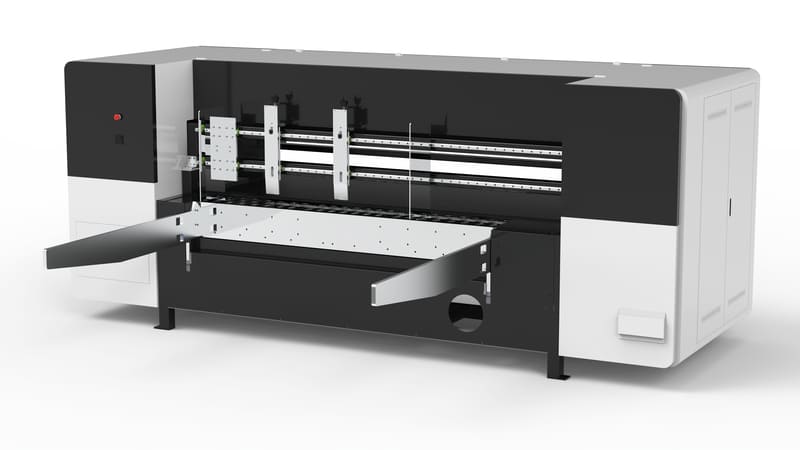
Cost-effective digital printing equipment does not beat outsourcing because it is cheaper on paper. It beats outsourcing when the pattern of your orders makes the outside supply chain expensive in ways that never appear on an invoice. Brand owners usually start this comparison with a per-unit price and finish it with a different question entirely: who controls the lead time, the version changes, and the quality of the box that carries my name?
I work on the export side of packaging machinery, and I sit in on a lot of these evaluations. The customers who get this decision right are not the ones with the sharpest spreadsheet. They are the ones who list every cost that outsourcing hides, and then check whether those hidden costs are growing. Let me walk through the framework we use with them.
In one sentence: outsourcing wins when your artwork is stable and your volumes are large; bringing printing in-house with cost-effective digital printing equipment wins when your artwork changes often, your runs are short, and your lead time is being set by someone else.
Start With the Order Profile, Not the Price
Before anyone compares quotations, describe the orders honestly. How many distinct designs do you run in a quarter? How often does a design change after it has been approved? What is the smallest quantity you ever order, and how many of those small orders do you place? What is the longest you can wait between approving artwork and receiving boxes?
Those five answers divide almost every business into two groups. Group one runs a handful of designs with long production cycles and few changes — outsourcing suits them, and buying equipment would be solving a problem they do not have. Group two runs many designs, changes them frequently, orders in small quantities, and needs to move quickly — and for them, every one of the hidden costs below is quietly compounding.
The Costs Outsourcing Hides
None of the following usually appears as a line on a supplier quotation, which is exactly why they are easy to miss. They appear instead as delays, inventory, and reduced flexibility.
- Lead time you do not control. Your launch date now depends on someone else's production queue. When a campaign moves forward by a week, your packaging cannot always follow.
- Plate and set-up cost carried inside the unit price. Every short run from an outside supplier absorbs make-ready, whether or not you can see it. Order in small quantities and you pay for that set-up again and again.
- Freight and handling on small volumes. Moving a modest quantity of boxes between two sites costs what it costs, and small shipments rarely get the best rate.
- Safety stock held as insurance. When lead times are unpredictable, the rational response is to order early and store more. That inventory ties up cash and warehouse space without adding a single sale.
- Rework and re-approval cycles. A misread colour or a shifted panel means a new round trip, and the calendar cost lands on your product launch.
- Versioning friction. If adding a regional variant means another run, another plate, and another delivery, most brands simply stop making variants. The lost opportunity never shows up in the accounts at all.
The Costs Owning Equipment Adds
An honest make-or-buy comparison lists the other side of the ledger too. Bringing printing in-house means accepting floor space, an operator's time, consumables, and maintenance as your responsibility. It means the machine has to be fed and scheduled, and it means someone has to own the quality of what comes off it. If your organisation has no one to take that on, the arithmetic does not matter.
What has changed in recent years is how much of the operator burden the equipment itself absorbs. The presses we build are designed so that no specialist pressman is required to run a job — the colour matching is handled in software, the settings are stored as presets, and a changeover is a matter of loading a file rather than mounting a plate and dialling in registration. That does not eliminate the need for an owner, but it means the person who owns it does not have to be a flexo veteran.
| Decision factor | Favours outsourcing | Favours owning equipment |
|---|---|---|
| Design changes per quarter | Few, and planned well ahead | Many, and often late |
| Typical order quantity | Large and repeatable | Small and irregular |
| Need for variants | One market, one design | Multiple markets or channels |
| Warehouse space | Plenty of room for safety stock | Tight, and stock is a burden |
| In-house production capability | None, and none planned | Existing plant, finishing, or packing lines |
| Speed to market | Long planning cycles | Campaigns that move at short notice |
Where Cost-Effective Digital Printing Equipment Changes the Maths
Two structural features of digital printing remove costs that analog printing cannot avoid, and they are the reason this category exists at all. The first is the absence of plates. There is nothing to engrave, mount, clean, or store, so the set-up cost that dominates small orders in flexo and offset simply disappears. The second is the one-minute job change. Once set-up is measured in seconds rather than in a plate change, the economic floor for a viable run drops dramatically — the press can print from a single box upward without the economics turning upside down.
Those two features have a third consequence that matters to brand owners specifically: versioning becomes almost free. Adding a language variant, a regional panel, or a promotional flash is a file edit and a new job, not a new plate. Brands that could never justify five versions of a carton can now run five, and they usually discover demand they did not know they had.
Where the phrase "cost-effective" is most often misused is in the assumption that it means inexpensive to buy. On a shop floor it means something different: cost per usable box, measured across a shift, including downtime and waste. That is why we ask customers about their uptime habits before we talk about price at all. A press that runs steadily and changes jobs cleanly will beat a cheaper machine that stops for maintenance twice a shift, every time — and the difference shows up in the box, not in the invoice.
What to Look For in Equipment You Plan to Own
If the order profile points toward owning, the specification list is shorter than most buyers expect. Match print width to the largest artwork you actually run, not to the largest the machine can handle — extra width costs ink and maintenance. Choose the head family that suits your dominant substrate, with Epson Micro Piezo heads covering 8 to 32 heads at 600 or 1200 DPI for detailed work, and industrial heads where durability and volume matter more. Insist on a five-colour CMYKW configuration if any of your packaging involves non-white board, because white coverage is the difference between a design that survives the substrate and one that fights it.
Then check the two things that decide long-term cost: the feed section and the data connection. A machine with automatic leading-edge feeding holds registration across a mixed schedule and needs less operator intervention. A machine that connects to your ERP system means job data arrives without re-keying, which removes a whole category of small errors. Both are described across our platform ranges, and you can compare head families on our printhead overview or look at the full product range.
A Brand Owner Who Made the Switch
A mid-sized consumer brand in Western Europe used to buy its cartons from a contract printer and had accepted the arrangement for years. The trigger for change was not price. It was a product launch that slipped by a fortnight and left them with a ready promotion and no packaging. The second trigger was a regional expansion that required four language variants of the same carton — four plates, four runs, four delivery dates.
They brought a digital press in-house, not to print everything, but to print the fast-moving and multi-variant portion of their range. Long runs stayed with the contract printer, where the economics still worked. The change that surprised them most was not cost. It was that their design team started proposing variants again, because variants no longer triggered a procurement cycle. Nothing in their accounts recorded that benefit, and it turned out to be the largest one.
FAQ — Make or Buy for Packaging Printing
Do I have to bring all my printing in-house?
No, and most customers do not. The usual pattern is to keep long, stable runs with the contract printer and move short, frequent, or multi-variant work onto your own equipment.
What makes cost-effective digital printing equipment cost-effective?
Plates are eliminated and job changes take about a minute, so set-up stops dominating short orders. Cost-effectiveness shows up as cost per usable box across a shift, including downtime and waste.
Do I need an experienced press operator?
Not in the flexo sense. Colour matching is handled digitally and settings are stored as presets, so the machine does not require a specialist pressman. Someone still has to own scheduling and quality.
Is outsourcing ever the better answer?
Yes. If your designs are stable, your quantities are large, and you have no production capability or appetite to build one, a contract printer will usually serve you better than an under-used machine in your own building.
Final Word: Compare the Whole Chain, Not the Unit Price
The make-or-buy question is decided by order profile, not by price comparison. Count the design changes, the variants, the small orders, and the weeks you spend waiting. If those numbers are rising, the hidden costs of outsourcing are rising with them, and cost-effective digital printing equipment starts to look less like a capital expense and more like a way to take control of your own launch calendar.
If you want help working through that comparison, send us a quarter of your order history. We will tell you honestly which portion belongs on your own press and which should stay with your current supplier.
Deciding what to print in-house?
See which configurations suit short runs, frequent version changes, and mixed substrates before you commit to a purchase.
Match a Press to Your Order MixNot sure which orders should move onto cost-effective digital printing equipment?
Send us a quarter of order data and we will mark which lines belong in-house and which should stay outsourced.
Get a Make-or-Buy Analysis