The question "what is the smallest order that justifies a short-run digital printing machine" has no single answer, because the number depends on what you are comparing it with. What can be answered precisely is the shape of the calculation — and once you see the shape, you can run it on your own numbers. The pivot is setup: analog printing charges you for it on every order, and digital printing does not.
I have spent 15+ years on the export side of packaging machinery, and I have sat through a lot of these evaluations. The ones that go wrong usually compare a single quotation for a single order. The ones that go right count how many designs the plant runs per month, because that figure — not the order size on its own — is what decides whether digital equipment earns its place. Let me walk through it without inventing prices, because you already know your own numbers better than I do.
In one sentence: a short-run digital printing machine pays for itself when the cost of setup repeated across many small orders exceeds the annual cost of owning and running the machine — so the two figures that matter are how many designs you run per year and how much setup each one carries.
The Only Cost That Behaves Differently
Every printing process carries two cost components: a setup cost that is incurred once per design, and a running cost that is incurred per unit. Analog printing has a substantial setup cost — plates, mounting, registration, and the material consumed while the press is brought into colour. The running cost per box is then very low, because ink and board are cheap relative to the setup.
Digital printing effectively removes the setup component. There is no plate to make, no registration to dial in, and colour matching is handled digitally rather than by an operator adjusting the press. What remains is the running cost, which is higher per box than analog for most substrates.
That structure produces a crossover point. Below a certain quantity per design, the saved setup outweighs the higher per-box cost and digital wins. Above it, analog wins. The crossover quantity varies by substrate, artwork, and machine, which is why nobody can quote a universal figure — but the logic is the same in every plant.
| Quantity per design | Which cost dominates | Usual winner |
|---|---|---|
| Very small quantities | Setup dominates entirely; per-unit price is almost all setup | Digital, decisively |
| Short and medium quantities | Setup and running cost are comparable | Depends on the crossover; this is where the real evaluation happens |
| Long quantities | Running cost dominates; setup is spread thinly | Analog, on cost |
The Figure You Should Actually Count
Order size alone is a misleading metric, because a plant that runs one small order a month is not a candidate for a machine and a plant that runs forty is. The number that predicts the outcome is designs per year — how many distinct pieces of artwork go through production across twelve months. Every one of those designs carries its own setup cost in an analog workflow, and those costs accumulate invisibly.
So the walkthrough is short. Count the designs. For each, note the quantity. Ask your current supplier what portion of the price they attribute to make-ready, or estimate it from how their price changes between quantities. Multiply the setup you avoid by the number of designs, and compare the total against the annual cost of owning a machine — which includes the machine itself, consumables, operator time, maintenance, and floor space.
Two adjustments are frequently forgotten. The first is reprints: a design that changes after approval carries setup twice. The second is variants. If a single campaign becomes four market-specific versions, that is four setups in an analog workflow and four files in a digital one. Both adjustments push the calculation further toward digital, and both are easy to overlook because they are counted as separate jobs rather than as one campaign.
The Costs That Belong on the Other Side
The comparison is only honest if the ownership side is counted properly. Five costs belong in that column, and the last two are usually the ones that decide the answer.
- Consumables. Ink and substrate, which for digital work are a larger share of each box than in analog printing.
- Operator time. Lower than a flexo press requires, because colour matching is digital and settings are stored as presets rather than dialled in by hand.
- Maintenance and head care. A routine rather than a repair cycle, but a real cost that has to be scheduled and staffed.
- Floor space and inventory. The machine displaces something. On the benefit side, eliminating stored plates and the safety stock that unpredictable lead times encourage frees space back.
- Lead time. Not a cost on an invoice, and frequently the largest single benefit. A design that can be printed the day it is approved changes how a business plans launches, promotions, and stock.
Where a Short-Run Digital Printing Machine Stops Being the Right Answer
It is worth saying plainly what digital does not do well, because a supplier who claims otherwise is not helping you. If your business is built on a small number of designs produced in very large quantities, analog printing will beat digital on cost and should keep the work. If your artwork is stable and your quantities are predictable, the setup cost you are avoiding is small and the calculation will not favour owning a machine.
Most plants, in our experience, are mixed. The realistic answer for them is not to move all printing in-house but to split the work: long stable runs stay with the contract printer, and the short, frequent, and multi-variant portion moves onto their own machine. That split is usually where the economics are strongest, and it is how the majority of the machines we ship end up being used.
Configuring for Short Runs
If the calculation points toward owning, the specification follows from the order profile. Match print width to your largest artwork rather than to the maximum available, and choose the head family for your dominant substrate — Epson Micro Piezo heads across 8 to 32 printheads suit detail-critical work at 600 or 1200 DPI, while industrial heads from Xaar and Seiko suit heavier duty cycles. Include a five-colour CMYKW configuration if any of your work sits on non-white board.
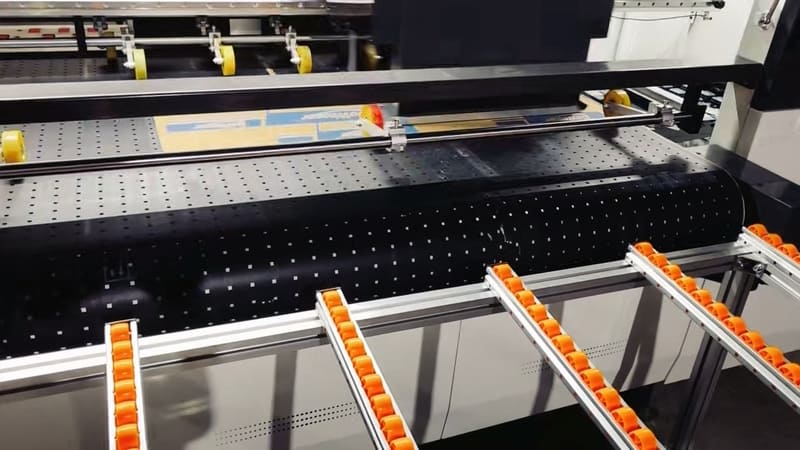
For a plant built on short runs, two features matter more than headline speed. Automatic leading-edge feeding keeps registration steady when every job is different, and a connection to your production systems means job data arrives without re-entry — which is what allows a queue of small jobs to move without an operator standing at the machine between each one. Our full range can be connected to a plant ERP system and linked to a high-speed printing unit, a slotting unit, and an automatic stacking unit. You can compare the families on our product range page and the head platforms on our printhead overview.
A Converter Who Ran the Numbers Twice
A converter in Eastern Europe first concluded that digital did not pay. They had compared the price of one of their larger orders, decided the per-unit figure was higher than their current supplier, and stopped there. Their analysis was correct for that order and wrong for their business.
When they returned a year later, they had counted designs rather than orders. Their annual artwork count was far higher than they had assumed, and a large share of those designs were running in quantities far below their large orders. Most importantly, several of those small jobs were being produced at a loss and had simply been accepted as the cost of keeping customers happy. Once the count was on paper, the conclusion reversed. They installed a press for the short and variable portion of their range and left the long work where it was.
FAQ — Short Runs and Break-Even
What quantity makes a short-run digital printing machine worthwhile?
There is no universal figure, because the crossover depends on substrate, artwork and your current setup cost. The metric that predicts it is designs per year, not the size of any single order.
Should I move all my printing in-house?
Rarely. The strongest economics come from splitting the work: short, frequent and multi-variant jobs in-house, long stable runs with your existing supplier.
How do I estimate the setup cost I am currently paying?
Ask your supplier how their price changes with quantity. The difference between a small and a large order price largely represents make-ready and material consumed while the press is brought into colour.
What is the biggest benefit customers report?
Control of lead time. Being able to print a design the day it is approved changes how a business plans promotions and stock, and that benefit never appears on a cost comparison sheet.
Final Word: Count Designs, Not Orders
The break-even question is easier than it looks once you stop comparing single orders and start counting campaigns. Every design carries a setup cost in an analog workflow, and those costs are the ones a short-run digital printing machine removes. Count how many designs you run in a year, add the variants and reprints you would consider if they were free, and compare that total against the cost of owning and running the machine.
If you would like help running it, send us a quarter of order history with quantities and design counts. Our technical team will walk through the calculation with you and say honestly whether a short-run digital printing machine belongs in your plant, or whether your current arrangement is already the right one.
Working out whether short runs can pay?
Compare platform widths and throughput options before you size a machine to your smallest orders.
Find a Short-Run PlatformSend us your design count and quantities
We will run the break-even analysis with you and tell you which portion of your work a short-run digital printing machine should take.
Request a Break-Even Review