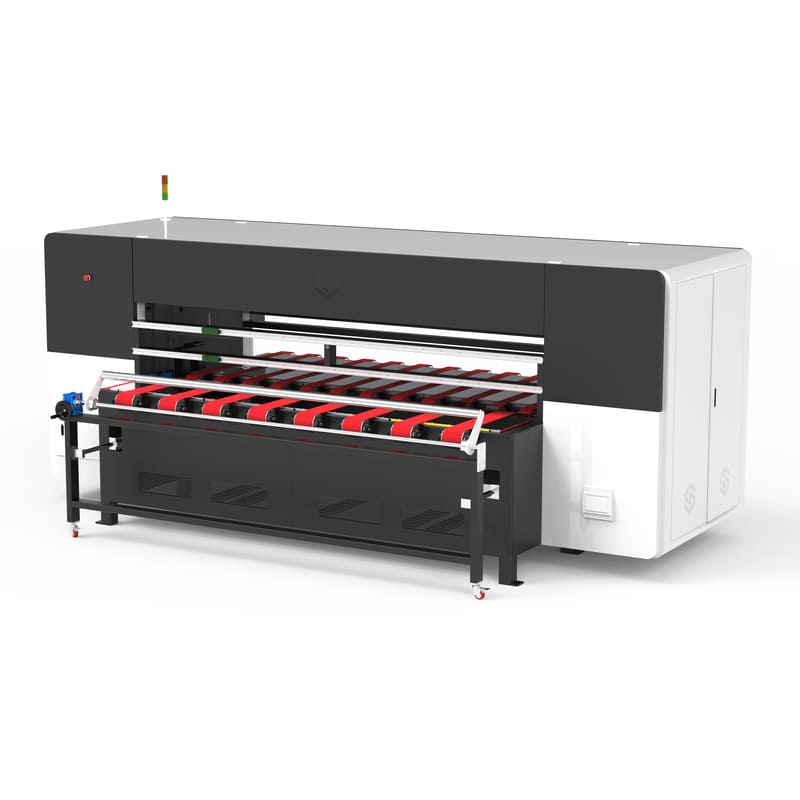
A plateless digital printer does not just remove a manufacturing step. It removes a design constraint that packaging teams have worked around for decades without always realising it was there. When every version of a design carries its own plate, the number of versions becomes a budget decision. When the plate disappears, the design team is free to propose ideas that were previously uneconomic — and that is a bigger change than the process description suggests.
I have spent 15+ years on the export side of packaging machinery, and the most interesting conversations I have are not about speed or resolution. They are with brand owners who suddenly ask what else they could do — regional variants, seasonal editions, personalised packs, test-and-learn campaigns — because the cost structure that made those ideas impractical no longer applies. Let me go through what actually changes.
In one sentence: a plateless digital printer turns versioning from a plate-and-budget decision into a file-and-schedule decision, which changes what designers can propose, how quickly brands can test an idea, and how late a change can be made before production.
What the Plate Actually Takes Away
A printing plate is a physical commitment. Once it is made, the design it carries is fixed, and it stays in a rack until the design is retired. That commitment creates three consequences that designers feel even if they never touch a plate. Each version needs its own plate. Each change after approval needs a new plate. And every plate produced has to be stored, tracked, and eventually discarded.
Teams adapt to those constraints by simplifying. They reduce the number of versions, accept one design for several markets, avoid late corrections, and keep a conservative margin on artwork because a re-cut is expensive. None of that appears in a design brief, and all of it shapes the outcome. On our platforms there is no plate anywhere in the process: the artwork goes from file to printhead as data, and each job change is a matter of loading a new file. Colour matching is handled digitally rather than by an operator adjusting a press, and no specialist pressman is required to run a version change.
Versioning Without a Penalty
Versioning is where the change is felt first. A brand selling into several markets normally needs translated text panels, different regulatory information, and sometimes different brand presentation. Under analog printing, each of those variants is a separate production route. Under plateless printing, they are a sequence of jobs on the same machine, with about a minute between them.
The practical consequence is that the version count stops being the first thing cut in a budget meeting. Brands that used to run one generic pack for four markets can run four specific packs at similar effort, and the improvement in market relevance is easy to argue commercially. We have watched customers expand their variant range simply because the production constraint that had kept it small was no longer there.
Personalization and Limited Editions
The next step beyond versioning is producing artwork that differs within a run. Because the image exists only as data, one box can differ from the next without slowing the press. That makes limited editions, event-specific packaging, and personalised packs practical rather than theoretical — a name, a location, a campaign code, or an entirely different panel can be printed in sequence on the same line.
In our experience the most successful uses of this are modest rather than extravagant. A regional coffee roaster printing a different origin panel each month, a cosmetics brand producing a numbered edition for a launch event, a food producer adding a seasonal design for a few weeks — these are cases where personalization is a marketing tool with a clear purpose, and where the quantities are far too small to justify a plate. The freedom is not about printing one box at a time for the sake of it; it is about not having to design around a minimum.
Proofs and the Approval Cycle
Design approval is where plateless printing quietly saves the most time, and it is the benefit customers underestimate most when they first evaluate a machine. A physical proof can be produced from the file on the same press that will run the production job, on the same substrate. The client holds the actual packaging rather than a screen image, and approves it in the meeting instead of a week later.
Because the proof and the production run come off the same machine with the same stored settings, the approved sample and the delivered packaging match each other far more closely than in a workflow where proofing and production are separate processes. That single continuity removes an entire category of disputes, and it also makes late design changes almost painless: a correction is a file edit and a new job rather than a new plate and a new scheduling conversation.
| Design activity | With plates | Plateless digital |
|---|---|---|
| Adding a new version | New plate, new run, new schedule slot | A new file and a one-minute changeover |
| Late artwork correction | Costly once a plate exists; often accepted as-is | Edited and reprinted without re-tooling |
| Physical proof | Often a separate process with its own tolerances | Same machine and settings as production |
| Small test batch | Set-up cost usually rules it out | Practical from very low quantities upward |
| Plate storage and obsolescence | Racks to maintain, plates to retire | Artwork lives as a file, not as hardware |
The Storage Cost Nobody Counts
Ask a plant manager about plate storage and you will usually get a tired answer. Plates occupy floor space, they need to be identified and retrieved reliably, and a plate that has been stored badly can fail when it is finally needed. None of that appears in a design budget, and all of it disappears when the artwork exists only as a file. For a plant with limited floor space, removing a plate rack is a genuine capacity gain — and a digital press that avoids storing plates also avoids storing the pallets of board that analog short runs often require.
Where the Freedom Is Still Bounded
Design freedom is not unlimited, and a supplier who implies otherwise is not being straight with you. Three boundaries matter. The substrate still sets the rules — a kraft liner will mute colours unless a white base is printed first. Very long runs of a single design remain the domain of analog printing, where set-up cost is fully amortised. And specialist finishing effects that depend on a physical tool are still a separate process; plateless printing removes the plate from the image, not from the whole workflow.
Within those bounds, however, the design space opens considerably. Our range spans scanning, single-pass, and two-in-one platforms with print widths from 200 mm to 1800 mm depending on the head family, and five-colour CMYKW configurations where the artwork needs an opaque white base. You can see how these are grouped on the product range page and read about the inline finishing options under solutions.
A Brand That Started Testing Ideas
A food brand in Western Europe brought a plateless press in-house to handle short runs and promotional packs, and the change that surprised them was not operational. Their design team started proposing campaigns that had previously been rejected on cost grounds — seasonal packs, regional variants, and small trial runs for a new product line. Because a trial pack no longer required a plate, the marketing team could test a design in a few stores before committing to a national launch.
The brand's own summary was that the machine had changed their decision-making rather than their printing. Ideas that used to need a full budget now needed a file. That is the real design freedom a plateless digital printer delivers: not the ability to print anything, but the ability to test anything.
FAQ — Design Freedom With a Plateless Digital Printer
Can a plateless digital printer print a different design on every box?
Yes, because the image is data rather than a physical plate. In practice, most customers use that capability for editions, campaigns and regional variants rather than fully unique packs for every unit.
How late can artwork change before production?
Much later than with plate printing, because there is nothing physical to remake. Once the plate exists, a change is expensive. Without one, it is an edit and a new job.
Does plateless printing remove the need for physical proofs?
No, it improves them. The proof can be printed on the same machine and substrate as the production run, so what the client approves is what the plant delivers.
Is versioning still limited by anything?
By substrate behaviour, by ink performance, and by how many jobs your schedule can absorb. The plate constraint disappears; the production reality does not.
Final Word: The Constraint You Stop Designing Around
The most valuable thing a plateless digital printer changes is not visible on a specification sheet. It is the disappearance of a constraint that packaging teams had quietly accepted: that every idea needs a plate, that every version costs money, and that every late change is a negotiation. Remove the plate and you remove the reason to say no — and design freedom, in the end, is simply the ability to keep saying yes.
Send us the version structure you would run if the cost of another design were not a factor. Our technical team will tell you honestly what a plateless digital printer can produce from that list, and where the boundaries still sit.
Want more versions without more tooling?
See which platform widths and colour configurations best support versioning, editioning and short test runs.
See Versioning-Ready PlatformsSend us the versions you would run if plates were not a factor
Share your market list and artwork structure, and we will show what a plateless digital printer can produce from it.
Discuss a Version Plan