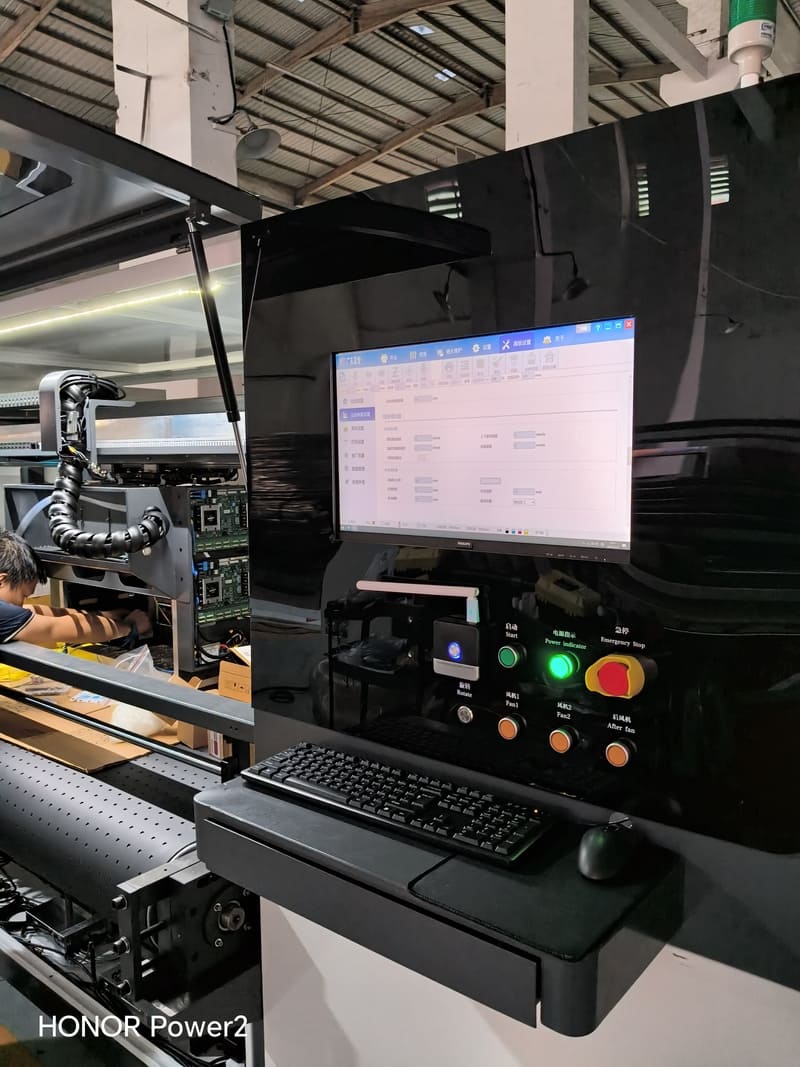
If you are buying a CE certified machine using UV ink from outside the EU, the verification work belongs before the balance payment, not after the container lands. Once the press is on your floor, a missing or mismatched document is no longer leverage — it is a problem you own. I have watched buyers discover this at the worst possible moment, and the fix is straightforward: know exactly which three documents to demand, what each one must say, and which standards a UV curing press should be assessed against.
I handle export orders for a packaging machinery manufacturer in Dongguan, so I sit on the other side of this table. I have assembled conformity files for shipments to Europe and to markets that reference EU rules, and I have also watched customers do the check properly and catch genuine gaps in suppliers' paperwork. This is the process I would hand to a buyer, in the order I would run it.
In one sentence: verify three things before you pay — the marking on the machine nameplate, a Declaration of Conformity that names your exact model and serial number, and the existence of a technical file assessed against the standards that apply to UV curing equipment.
Why the Check Has to Happen Before Payment
Commercial leverage disappears the moment the machine ships. Before dispatch, a supplier who cannot produce the conformity documentation has an obvious incentive to fix the problem quickly, because the balance payment is still on the table. After arrival, the same supplier has been paid, the machine is installed, and your only remedies are slow. Meanwhile the costs of a missing document land on you: a customs broker asking for evidence at the port, an insurer requiring proof that installed machinery meets the directives, or a customer audit that stops a line until the file appears.
There is a second reason to check early. Verification also tells you whether the supplier actually understands conformity, or simply repeats the phrase in a quotation. A supplier who can name the directives and the harmonized standards their machine is assessed against is usually a supplier who built the machine to meet them. A supplier who can only say "yes, CE" is a supplier you will be chasing for months.
Document One: The Marking on the Machine
The nameplate is the first thing to photograph, and it should be photographed on the actual machine your order number refers to — not taken from a brochure or a sister machine in the showroom. A compliant nameplate for industrial machinery carries the CE letters in the prescribed proportions, together with the manufacturer's name and address, the machine model or type, the serial number, and the year of manufacture. Additional data may include rated voltage, frequency, and rated current.
Ask for that photo before dispatch and check the serial number against the machine you are paying for. It is a two-minute task that catches a surprisingly common problem: documentation issued for a standard model while the machine being shipped carries a modified configuration. On a UV ink press this matters more than on simpler equipment, because the curing system, its power supply, and its shielding are all part of what was assessed.
Document Two: Reading the Declaration of Conformity
The Declaration of Conformity is the document that actually makes the claim, and it is where loose paperwork gives itself away. A usable declaration is specific, not generic. Read it against this list and treat any missing item as a question to put in writing.
- The machine is named precisely. Model or type designation and, where the manufacturer tracks it, the serial or batch reference. A declaration that covers "digital printing machines" as a category is not a declaration for your machine.
- The manufacturer is identified. Full legal name and address, with the authorised representative inside the EU named separately if the manufacturer is based outside it. That representative is the entity an EU authority will contact.
- The directives are listed. For a UV ink press, expect the Machinery Directive and the Electromagnetic Compatibility Directive as a minimum, and the Low Voltage Directive where the electrical scope applies.
- The harmonized standards are cited. Not just the directive names — the specific standard numbers the assessment relied on. This is the detail that separates a prepared file from a copied template.
- It is signed and dated. With the signatory's name and position, and dated after the machine was built, not before.
- A notified body is named only if one was involved. For most machinery categories, self-declaration by the manufacturer is normal and correct. A claim that a notified body certified everything, with no name or number to check, deserves a follow-up.
The Standards a UV Curing Press Should Be Assessed Against
Buyers often ask which standards apply, and it is a fair question — the answer reveals how much thought went into the conformity work. The list below is not exhaustive, and the exact set depends on how a machine is built, but these are the standards we expect to see cited on an industrial inkjet press with UV curing.
| Area of the machine | Standard commonly cited | What it addresses |
|---|---|---|
| Overall machine safety | EN ISO 12100 | Risk assessment methodology and risk reduction principles |
| Electrical equipment | EN 60204-1 | Electrical equipment of machines: isolation, emergency stop, protection |
| Safety-related control systems | EN ISO 13849-1 | Performance level of interlocks, guards, and stop functions |
| Electromagnetic emissions | EN 61000-6-4 | Emission limits for equipment used in industrial environments |
| Electromagnetic immunity | EN 61000-6-2 | Immunity requirements so the press keeps printing near other equipment |
| UV lamp and LED safety | EN 62471 | Photobiological safety of lamps and lamp systems |
The last row is the one specific to your category of machine, and it is the row most often missing from supplier paperwork. UV curing systems emit in a range that can affect eyes and skin, so a competent file addresses lamp and LED safety explicitly. If a supplier lists the electrical and EMC standards but has nothing on photobiological safety, ask why. The answer tells you whether the file was assembled for the machine or for the conversation.
Document Three: The Technical File, and What You Can See
The technical file is the manufacturer's internal evidence pack behind the declaration, and you should not expect to receive it in full — parts of it are legitimately confidential. What you can and should ask for is confirmation that it exists, what it contains by category, and confirmation that it corresponds to your serial number. For a UV ink press, a complete file normally covers the general machine description and drawings, the risk assessment, the electrical schematics, the list of standards applied, the test results, the instructions for use, and the declaration itself.
The one part of that pack you must insist on receiving is the operating instructions in the language of the destination country, along with the safety documentation. These are not courtesies. They are a condition of placing the machine into service in the market, and they are also the documents an inspector or an insurer will ask to see on site. A machine delivered without them is a machine that will sit idle while the paperwork is produced.
Writing It Into the Purchase Order
Verification is easier when the obligation is contractual rather than conversational. These are the clauses we routinely see competent buyers include, and which we are comfortable signing because we ship the documents anyway.
- A signed Declaration of Conformity naming the exact model and serial number, issued as a condition of the balance payment.
- A photograph of the machine nameplate, showing the CE marking and the same serial number, before dispatch.
- Operating and safety instructions in the destination country's language, supplied both as printed copies and as digital files.
- A written statement of the directives and harmonized standards the machine was assessed against, including lamp and LED safety.
- Confirmation that a technical file exists for the serial number and can be made available to a market surveillance authority on request.
Two Situations Buyers Have Brought to Us
The first came from a distributor in Central Europe who had been quoted a lower price by another supplier and asked us to help them compare the two offers. The competing quotation said "CE certified" in the specification line and nothing else. When the distributor asked for the declaration, the reply was a photocopy with no model number and no standard citations. They walked away. Their reasoning was practical rather than idealistic: as the importer, they would have carried the liability, and their own customers were asking for conformity evidence in tender documents.
The second came from a buyer in the Middle East whose bank required the conformity documentation as part of a financing package. The machine had already been paid for, and the file arrived in pieces over several weeks. Installation slipped past the plant's start-up date, and the delay cost far more than the documentation would have. The lesson from both stories is the same: the file is part of the machine, and it should be treated as a delivery item with a deadline attached.
A Note on Markets That Reference EU Rules
Even if your plant is not inside the EU, the check is rarely wasted. Many markets in the Middle East, Africa, and Asia reference EU standards in their import regimes, and international insurers and lenders increasingly expect conformity evidence as a matter of course. A complete file also travels well: if you later resell the machine, move it to a different site, or export it again, the documentation makes those steps routine instead of painful. Machinery built to those standards, with the paperwork to prove it, keeps resale value in a way that undocumented equipment does not.
Our position as a manufacturer is straightforward. The platforms we build — from compact scanning presses up to wide single-pass and two-in-one configurations — can be supplied with the conformity documentation for the destination market, and you can see how the ranges and head platforms are organised on our industrial printhead series page and under service and support. We would rather answer the document question in the first email than in month three.
FAQ — Verifying a CE Certified Machine Using UV Ink
Can I verify a CE certified machine using UV ink without visiting the factory?
Mostly, yes. A nameplate photograph, a model-specific signed declaration, and a written list of directives and standards cover the substance. A pre-shipment inspection adds the confirmation that the marking is physically on the machine.
Is a CE certificate the same as a Declaration of Conformity?
No, and this trips up a lot of buyers. For most machinery the manufacturer issues a Declaration of Conformity under their own responsibility. A separate certificate is only relevant when a notified body is involved for the applicable category.
Why does UV curing change the conformity scope?
UV curing adds high-power electrical sub-systems and lamp or LED emission considerations. That is why the file should address both EMC and the photobiological safety of the light source, not just general machine guarding.
What if the machine arrives without the documentation?
You lose most of your leverage, which is exactly why the check belongs before payment. If it happens, put the request in writing immediately, specify the exact document set, and keep installation sign-off conditional on receiving it.
Do instructions really need to be in my language?
In the EU and in markets referencing EU rules, operating and safety instructions must be in the language of the destination country. Beyond compliance, they are what your operators will actually use during a fault at 2 a.m.
Final Word: Treat the Paperwork as Part of the Machine
A CE certified machine using UV ink is only as useful as the evidence that travels with it. Photograph the nameplate, read the declaration line by line against the model you are buying, confirm the standards include lamp and LED safety, and make the delivery of the documents a condition of payment. None of that takes more than a few emails, and all of it protects the schedule you have promised to your own customers.
If you are working through an import and want a second pair of eyes on the conformity pack before you release payment, send it over. Our export team reviews these files every week and will tell you plainly whether anything is missing.
Importing a UV ink press into a regulated market?
See which platform configurations are available with the conformity documentation for your destination.
View Export-Ready ConfigurationsWant the conformity pack checked before you pay?
Send us the declaration and standards list for your CE certified machine using UV ink. We will flag anything generic, incomplete, or mismatched to your serial number.
Request a Documentation Review