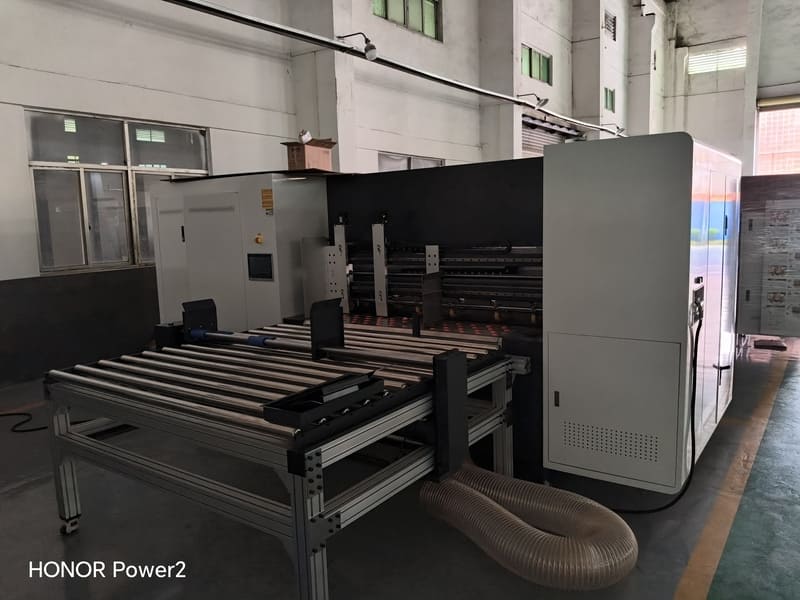
A printer with Xaar printheads is built for industrial duty, and industrial duty is exactly what wears components out. The printheads are the most valuable consumable part of the machine and the easiest to damage through neglect — not through hard use, but through inconsistent care. In our experience, the plants that get long head life out of these presses are not the ones with the gentlest jobs. They are the ones with a routine that runs every shift whether the machine is busy or not.
I have spent 15+ years on the export side of packaging machinery, and most of the head problems customers bring to us trace back to one of four causes: a nozzle that was left uncapped, ink that was never designed for the platform, dust from the board, or a shop that treats maintenance as something to do when a print degrades. Let me go through each, and then give you the schedule we recommend.
In one sentence: a printer with Xaar printheads stays productive when the heads are capped and purged on a fixed routine, fed only ink and consumables matched to the platform, and protected from the board dust that is the most common cause of a dropped nozzle.
What Is Inside a Xaar Head
Understanding the component explains the maintenance. The Xaar heads we build around carry either 1536 or 2560 active nozzles on a print width of 108.3 mm, with a native nozzle resolution of 360 npi arranged as 180 by 2 colour rows. Drop volume spans 13 to 100 pl, 25 to 215 pl, or 9 to 30 pl depending on the model, and jetting frequency runs up to 28 to 40 kHz, with maximum productivity in the region of 1500 to 2500 units per hour depending on the head. That is a dense, precise assembly of very small channels.
Two characteristics follow from those numbers. First, thousands of nozzles means a single blocked channel affects only a fraction of the image — which is good for fault tolerance, and bad for detection. A partially blocked nozzle can go unnoticed for days while quietly degrading fine detail or leaving a faint line in a solid panel. Second, high jetting frequency means the head is working hard during production, so the idle period between jobs is when the ink inside those channels is most at risk of drying or settling.
The Daily Routine That Protects the Heads
None of the following is complicated, and collectively it accounts for most of the difference between a head that lasts and one that does not. The key is that it happens on a schedule rather than in response to a visible problem.
- Print a nozzle check at start-up. Every shift begins with a test pattern, not with a production job. A missing segment shows up in a test pattern immediately and in a printed carton only after a pallet has been produced.
- Purge and wipe before the first job. Purging moves fresh ink through the nozzles and clearing the nozzle plate removes accumulated debris. Done before the shift, it takes moments; done after a fault appears, it costs a run.
- Cap the heads when the machine is idle. Capping protects the nozzle plate from drying and from airborne dust. This is the single most important habit on the list, and the one most often skipped during a busy shift.
- Clear board dust from the feed area. Uncoated and recycled board sheds fibre continuously. Dust that reaches a nozzle plate becomes a blockage, and it is far cheaper to remove from the feed than from a head.
- Note anything unusual in a shift log. A faint line, a slightly weaker colour, a nozzle that needed two purges to clear — recording these turns a slow degradation into a trend you can act on.
Ink Compatibility: Where Money Is Quietly Lost
Ink is the other half of head life, and mixing suppliers is where plants run into trouble. A printhead is designed around an ink's viscosity, surface tension, particle size, and chemistry. Substituting a cheaper ink with different properties may print acceptably for a while and then cause problems that look like head failure: intermittent nozzles, poor drop formation, and sediment that cannot be purged out.
Our recommendation is straightforward. Use ink and consumables specified for the platform, keep a record of batch numbers, and never mix two suppliers' inks in the same system without flushing it properly. If a plant wants to evaluate an alternative ink, do it deliberately: run the evaluation on a defined set of jobs, keep the nozzle check records, and compare them against the baseline before switching the whole machine over. We have helped customers through exactly this comparison, and the ones who measured it usually found the cheaper ink was not cheaper once downtime was counted.
Filtration and degassing belong in the same conversation. Ink that carries particles or dissolved gas will perform inconsistently, and the resulting faults mimic head wear. When a customer reports that nozzle checks have become unreliable across several heads at once, we look at the ink supply before we look at the heads — a supply problem affects everything, while head wear usually affects one head first.
Dust, Temperature, and Humidity
Corrugated plants are dusty places, and dust is the enemy of an open nozzle. Two practical measures make a real difference. Position the press away from cutting, creasing, and other dust-generating processes if the layout allows. And keep the feed area clean on a routine rather than on a complaint — a quick clean of the infeed at the end of each shift is more effective than a deep clean once a month.
Temperature and humidity matter too, for a less obvious reason. Ink viscosity changes with temperature, and drop formation depends on viscosity. A shop that swings between hot afternoons and cold mornings will see print behaviour change with the weather unless the machine compensates or the environment is controlled. Similarly, low humidity increases static, which affects both sheet handling and dust attraction around the print zone. If your press is in a space with no environmental control, build the seasonal adjustments into your recipes deliberately rather than discovering them in a reject pile.
| Interval | Task | Why it matters |
|---|---|---|
| Every shift | Nozzle check pattern, purge and wipe, clean the feed area | Catches partial blockages before they reach production board |
| Between jobs and at the end of the shift | Cap the heads; confirm the machine is in its idle state | Prevents drying and settling inside thousands of fine channels |
| Weekly | Review nozzle check records, inspect ink supply and filters, check the print zone for dust build-up | Turns isolated incidents into a visible trend |
| Monthly | Inspect transport, vacuum zones and air supply; verify per-grade recipes still hold | Keeps registration stable and avoids surprises after a grade change |
| As indicated | Replace a head that will not recover after proper purging and wiping | One degraded head affects one colour or segment; catching it early limits the impact on run quality |
When a Head Needs Replacing
The decision is not as dramatic as it sounds. A head should be replaced when a nozzle defect persists after correct purging and wiping, when the same segment repeatedly fails in a spot that no cleaning routine resolves, or when the defect is visible in production and cannot be compensated by adjusting the recipe. Electrical failure — a head that stops firing entirely — is unambiguous, and rare compared with the gradual degradation that comes from debris and drying.
Two habits make replacement manageable. Keep a spare head on site if your production depends on a single machine, and record the replacement so the next occurrence is recognised faster. On our Xaar-based configurations — 6, 9, or 12 heads with five-colour CMYKW coverage, print widths of 200 mm, 300 mm, or 400 mm, and throughputs of 500, 800, or 1000 m/h — replacing one head is a service task rather than a rebuild, provided the plant has the routine and the documentation to spot the problem early. You can see how these configurations are grouped on our Xaar series page, and support arrangements are described under service and support.
A Plant That Changed One Habit
A converter in Southeast Asia reported recurring fine-line defects on a press that had been running for some time. Their maintenance practice looked reasonable on paper: the machine was cleaned regularly and nozzle checks were performed. The defect was intermittent, and it usually appeared late in the shift.
We asked about capping. The press was left uncapped during the long gaps between jobs — gaps that had grown as their order mix shifted toward shorter runs. Ink was drying at the nozzle plate during those idle periods and being partially cleared by the next purge, which is why the defect appeared late rather than early. Capping during idle time, plus a short purge before the first job of each block, resolved it. Nothing was replaced. The machine had been maintained on the assumption that a busy press needs less care, when the opposite is true.
FAQ — Looking After a Printer with Xaar Printheads
How often should a printer with Xaar printheads be purged?
Purge at start-up and after any extended stop. On a press running short jobs with gaps between them, capping plus a short purge before each block of work prevents the drying that causes most intermittent nozzle faults.
Can I use any ink in these heads?
No. Heads are matched to ink viscosity, surface tension and chemistry. Using unspecified ink may print for a while and then cause faults that look like head failure. Always flush properly before changing ink type.
Does board dust really damage printheads?
It is one of the most common causes of a dropped nozzle we see. Dust from uncoated and recycled board settles on the nozzle plate, and cleaning the feed area routinely is far cheaper than recovering a head.
How do I know when to replace a head rather than clean it?
When the same defect survives correct purging and wiping, appears in more than one nozzle check, and is visible in production. Gradual degradation from debris is more common than outright electrical failure.
Final Word: Uptime Is a Routine, Not a Repair
A printer with Xaar printheads is a durable industrial tool, and durability is not the same as invulnerability. The plants that keep these heads running for years share the same habits: a nozzle check every shift, capping whenever the machine is idle, only ink matched to the platform, and clean air around the print zone. None of it takes long, and all of it is far cheaper than a head replacement or an unexplained reject pile.
If you would like a maintenance routine written around your specific configuration and shift pattern, tell us which heads and how many jobs you run per day. Our technical team will put together a schedule your operators can actually follow.
Protecting head life on an industrial press?
Review the Xaar configurations and consumable requirements before you specify your next platform.
See the Xaar Printhead SeriesWant a maintenance schedule for your shift pattern?
Tell us how a printer with Xaar printheads is used in your plant and we will write the daily, weekly and monthly routine around it.
Ask for a Maintenance Plan