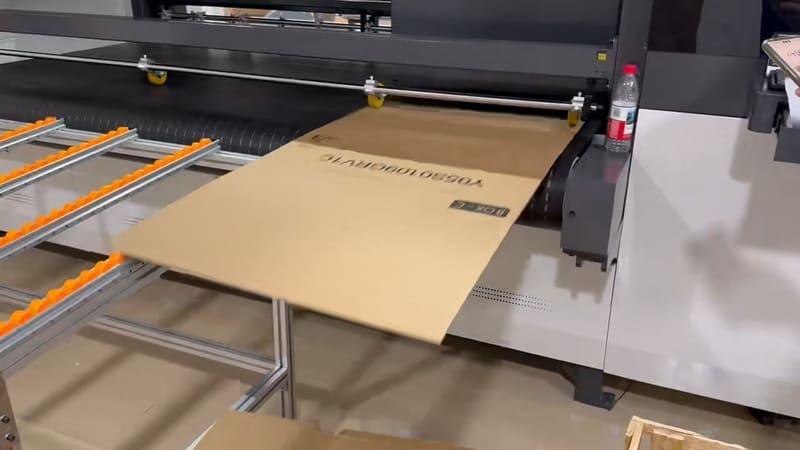
The print on a box is judged in the warehouse, not in the pressroom. A digital printer for water-resistant pigments exists because packaging graphics face three enemies after they leave the plant: moisture that condenses on cold surfaces, abrasion from handling and stacking, and light that fades ink over months of storage. If your cartons travel through a cold chain or sit in a humid distribution centre, the print has to be engineered for that journey from the start.
I have spent 15+ years on the export side of packaging machinery, and I have seen more print failures caused by logistics than by machinery. A job that looked flawless on approval can come back looking tired after a sea crossing. Let me go through what actually attacks a printed surface, which conditions are worst, and how to test a job properly before you approve it.
In one sentence: water-resistant pigments keep a print intact through condensation, handling, and long storage by bonding pigment into the surface rather than leaving it sitting on top, and by resisting the moisture cycles that a carton meets between your dock and the end customer.
Where Water Resistance Actually Gets Tested
A pressroom is a comfortable place: stable temperature, controlled humidity, and a printed sheet that goes from machine to stack without ever being touched roughly. Nothing that happens there reveals how a print will behave in a chiller aisle. The conditions that matter are all downstream — a frozen-food distribution centre where cartons move from a cold room to a humid loading bay, a beverage warehouse where pallets sit for months, a container crossing the equator where temperatures swing between day and night.
Buyers have started asking about this more often, and the reason is commercial rather than technical. When a retail customer receives a pallet of faded or scuffed packaging, the complaint comes back to the brand, not to the printer or the logistics company. Water resistance is therefore a brand-protection question as much as a print-quality one.
The Three Enemies, and How Each One Attacks
| Enemy | How it damages print | Where you see it first |
|---|---|---|
| Condensation | Liquid water forms on a cold surface and lifts or bleeds pigment | Cold chain, chilled aisles, cartons moved into humid bays |
| Abrasion | Rubbing between stacked cartons wears pigment off the surface | Pallet edges, high-contact areas, long road journeys |
| Light and time | Fades or shifts hues gradually across months of storage | Retail back rooms, window displays, slow-moving stock |
Notice that two of the three are mechanical rather than chemical. Condensation and abrasion both test how well the pigment is attached to the board, and that is decided long before the carton is packed — at the moment the ink is laid down and cured. A print whose pigment sits loosely on the surface will fail both tests. A print whose pigment has bonded into the liner will pass them.
What Water-Resistant Pigments Actually Mean
Two distinctions are worth understanding, because they explain why some prints survive a winter and others do not. The first is pigment versus dye. Pigment particles are insoluble and sit as solid colour, held in place by the ink's binder. Dyes dissolve into the liquid and can migrate when water is reintroduced. For packaging exposed to moisture, pigment-based systems are the foundation — the colour does not travel when water arrives.
The second distinction is how the ink is set. UV-curable inks are cured by exposure rather than by drying, which gives two advantages in wet or cold conditions. The cure is effectively instant, so the print is fully formed before the carton reaches the stacker — there is no window in which the surface is soft enough to smear or offset. And because the process does not depend on water evaporating out of the sheet, performance does not drift when ambient humidity changes during the shift. On cartons destined for cold chain or long transit, that combination is what makes the difference between a print that arrives fresh and one that arrives worn. You can see how these configurations are grouped on our five-colour line page.
The Cold Chain Is the Hardest Case
Cold chain packaging meets a specific and brutal physical cycle. A carton is stored at low temperature, so its surface becomes cold. It is then moved into a warmer environment — a loading bay, a delivery van, a shop floor — where warm humid air meets the cold surface and condenses into liquid water. That water sits on the printed area for as long as it takes the board to reach ambient temperature. Repeat the cycle several times between the factory and the freezer aisle and you have an effective, if unintended, water-resistance test.
Two factors determine whether the print survives. The first is pigment attachment, as above. The second is the board itself — moisture absorbed into an exposed liner softens the sheet, and a soft sheet scuffs more easily in the stack. This is why we ask customers about the destination before recommending a configuration. A frozen food carton going through a retail supply chain has different requirements from a dry-goods case that never leaves a warehouse, and the recipe should reflect that.
Export Transit: Container Rain and Long Days
Ocean transit adds a slow version of the same problem. A container crossing several climate zones experiences large day-night temperature swings, and moisture inside the container condenses on cool surfaces overnight. On a long route, that cycling can affect packaging near the container walls even when the goods themselves are dry on loading. The practical measures are familiar to exporters — desiccant, careful loading to avoid contact with walls, sensible stacking — but they are not a substitute for a print that resists moisture in the first place.
The other transit factor is simple duration. A print has to look correct months after it was produced, not days. That is why we encourage customers to test with time in the loop rather than relying on an immediate inspection, and why slow-moving SKUs deserve a harder look than fast sellers.
How to Test Before You Commit
You do not need a laboratory to get a useful answer. These four checks are the ones we recommend, and we are happy to run them on customer samples rather than describe them.
- Water drop test. Place a drop of water on a printed area and leave it for a fixed period. Watch whether the colour bleeds into the surrounding paper or sits still.
- Rub test. Rub a printed surface against a piece of the same board, by hand or with a simple weighted rig. This mimics stacking contact in transit better than any visual inspection.
- Condensation cycle. Chill the print, then move it to a warm humid space and observe what happens as the water forms. Repeat it more than once, because the second cycle is usually when weakness appears.
- Tape pull. Apply and remove adhesive tape from a printed area. If pigment lifts with the tape, the ink has not bonded and abrasion will eventually tell you the same story the hard way.
Configuring a Digital Printer for Water-Resistant Pigments
The machine side of this comes down to three choices. The first is the ink system and curing method, for the reasons already covered. The second is drop control: the same head platform has to build solid, well-bonded coverage on absorbent liners while keeping fine detail sharp where the artwork needs it, which is why we recommend configurations with a wide adjustable drop range rather than a single fixed profile. The third is the finishing side of the line — printed board that moves immediately into slotting and stacking avoids the handling stage that most often damages a print.
Our full range runs from compact scanning configurations up to wide single-pass platforms, with print widths from 200 mm to 1800 mm depending on the head family, and the machines can be connected to a high-speed printing unit, a slotting unit, and an automatic stacking unit to keep handling to a minimum. You can review the platforms on our product range page, and the support side of ownership is covered under service and support.
A Frozen Food Case From Our Records
A converter in Northern Europe was printing cartons for frozen vegetable packs and receiving a recurring complaint: the graphics looked fine when the pallets left the plant, and looked mottled when they reached retail. The pattern pointed to condensation, and a simple test confirmed it. A printed sample was chilled overnight, then exposed to warm humid air, and the pigment lifted at the edges of the dark solids.
The remedy was a change of recipe rather than a change of machine: a curing setup and ink profile that bonded the pigment more thoroughly, with the artwork adjusted so that heavy solids did not sit directly against the most moisture-exposed panels. The plant ran the same test monthly afterwards, using their own chiller and loading bay as the test rig. Their comment stayed with me — they had been inspecting prints in the one room where the problem could never appear.
FAQ — Water-Resistant Print on Packaging
Does water-resistant mean waterproof?
No. It means the print resists moisture, condensation cycles, and abrasion in normal packaging conditions. Immersion or prolonged soaking is a different test, and corrugated board itself would degrade before the print did.
Which is worse for print, humidity or abrasion?
In our experience abrasion causes more day-to-day damage, because it happens on every pallet edge in every journey. Condensation causes more visible failures, because the damage appears suddenly and looks alarming.
Do I need special board for cold chain packaging?
The board matters because a moisture-softened liner scuffs more easily, but the print recipe matters more. Many customers run standard grades successfully once the ink and curing profile are matched to the cold chain cycle.
How long should water-resistant print last?
It should look correct for the realistic life of the pack, including storage before retail. That is why we test with time in the loop rather than inspecting a fresh sheet and calling it proven.
Final Word: Judge Your Print in the Warehouse, Not the Pressroom
Water resistance is decided by the ink, the cure, and the handling between the press and the pallet. Get those three right and a digital printer for water-resistant pigments will keep your graphics looking correct through condensation, cold chain cycling, and a long sea crossing. Get them wrong and no amount of pressroom inspection will reveal the problem, because the pressroom is the one place it cannot happen.
Send us the destination and the storage conditions your packaging will face. Our technical team will recommend the ink and curing setup for that environment and run the tests on your own board before you commit to a specification.
Packaging that travels through cold chain or long transit?
Review the configurations that hold colour through moisture, handling, and months of storage.
Review Moisture-Resistant OptionsTell us where your cartons are stored and for how long
We will match a digital printer for water-resistant pigments to your humidity, temperature, and handling conditions, and prove it on your own board.
Request a Moisture Test